Hips often feel reluctant after a long desk session or a car journey, and mobility exercises for stiff hips can help. But “tight hips” is a sensation, not a diagnosis. The cause may involve inactivity, muscular guarding, joint irritation, back symptoms or a condition that needs assessment.
This 10 minute routine combines gentle movement with light muscle activity. None of the positions should create sharp pain, pinching in the groin, numbness or symptoms travelling down the leg.
- Mobility is control, not just range
- Mobility Exercises for Stiff Hips: The 10-Minute Routine
- How often should you do it?
- Adjustments for knees, balance and floor access
- Why hips feel stiff after sitting
- Telling a stretch from joint irritation
- What four weeks realistically looks like
- Adding strength so the new range is useful
- A desk day version
- Which pattern do you have if you are sitting all day?
- When stiffness may need assessment
- Use movement as information
- Frequently asked questions
Mobility is control, not just range
Flexibility describes the range available to a joint; mobility includes your ability to control that range. That is why this routine uses slow repetitions and brief holds rather than forcing a long stretch. A small comfortable range practiced regularly is more useful than pushing into pain once a week.
Mobility Exercises for Stiff Hips: The 10-Minute Routine
- Pelvic tilts 60 seconds: Lie on your back with knees bent. Gently alternate between flattening and releasing your lower back. Keep the movement small.
- Knee rocks 60 seconds: With feet on the floor, allow both knees to move a short distance side to side. Keep shoulders relaxed.
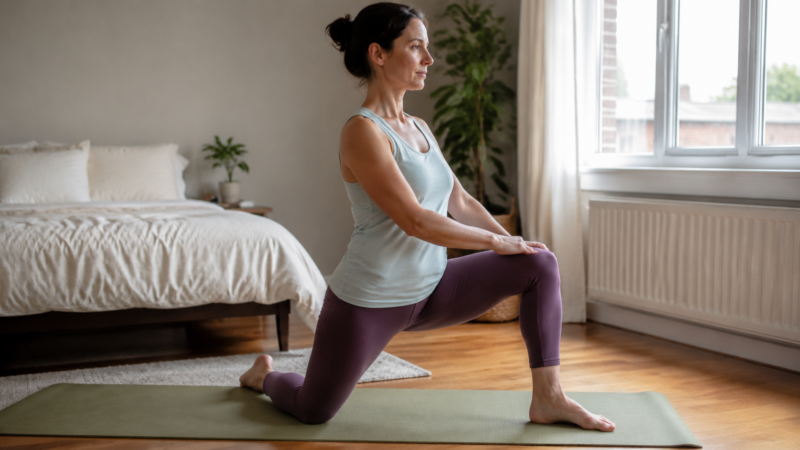
- Half kneeling hip flexor movement 90 seconds per side: Pad the back knee or stand in a split stance. Tuck the pelvis slightly and shift forward until you feel a mild stretch at the front of the back hip.
- Supported 90/90 switches 2 minutes: Sit with hands behind you and knees bent. Slowly guide the knees from side to side within a comfortable range.
- Figure four stretch 60 seconds per side: Lying or seated, cross one ankle over the opposite thigh. Stop if the knee feels strained.
- Glute bridge 10 controlled repetitions: Press through the feet and lift the hips without arching the lower back.
- Chair supported squat 8 repetitions: Sit back towards a chair and stand, using your hands if needed.
How often should you do it?
Try the routine three or four times a week, or use a shorter version after prolonged sitting. The aim is to finish feeling the same or slightly freer not sore. On busy days, perform knee rocks, the hip flexor movement and eight chair squats.
Mobility work also cannot cancel an entire day of stillness. Brief walking breaks and varied positions matter. If inactivity is the bigger issue, pair this routine with your current walking habit or the aerobic ideas in our exercise guide for healthy ageing.
Adjustments for knees, balance and floor access
If kneeling hurts, use a standing split stance. If getting to the floor is difficult, perform pelvic tilts while seated and use a chair for the figure four position. Keep one hand on a stable surface during standing work. Our fall prevention guide includes further ways to make home movement safer.

Why hips feel stiff after sitting
Sitting keeps the hips in one position for a long period. When you stand, the first few steps may feel restricted even when there is no structural problem. The sensation often changes once the joint and surrounding muscles have moved through several comfortable ranges. This is one reason frequent short movement breaks can feel better than a single long stretch at the end of the day. The NHS advice on sitting less makes the same practical point about the working day rather than about hips in particular: break up long periods of sitting with at least light activity, and set a reminder to get up roughly every thirty minutes.
The chair itself may contribute. A very low seat places the hips in deeper flexion, while a seat that is too high may leave the feet unsupported. Adjust the workstation so the feet rest comfortably and change position regularly. No posture remains ideal when held without variation for hours.
Telling a stretch from joint irritation
A muscular stretch usually feels broad and tolerable. It eases when you leave the position. Joint irritation may feel sharp, pinching, catching or deep in the groin. Symptoms that travel below the knee, include tingling or are accompanied by weakness may involve structures outside the hip muscles.
Do not try to prove flexibility by holding an uncomfortable position. Reduce the range or replace the movement. A standing hip flexor movement, a gentle bridge or an easy walk may be more suitable on that day.
What four weeks realistically looks like
Expect the first change to be in how quickly the stiffness clears rather than in how far you can move. In the first week or two, most people notice that the reluctant feeling after sitting lasts thirty seconds instead of two minutes. That is a real result even though nothing measurable has changed.
Range, if it moves at all, moves later and more slowly. By around week four you may find the half kneeling position more comfortable or the figure four easier to hold, which usually reflects better tolerance rather than a structural change. Strength changes on a similar timeline: bridges and chair squats feel steadier before they feel stronger.
What should not happen is a slow accumulation of soreness. If each week leaves you a little more irritable than the last, the routine is doing too much rather than too little, and the answer is fewer repetitions in a smaller range, not a different stretch.
Adding strength so the new range is useful
Mobility becomes more practical when you can control the range. The bridge trains the muscles that extend the hip. The chair squat practises using the hips and knees together during a daily task. Begin with a small range and use support, then gradually reduce assistance as confidence improves.
Two sets of eight controlled bridges and chair squats on two or three days each week can complement the mobility routine. The CDC activity guidance for older adults asks for muscle strengthening work on at least two days a week, which these two movements can contribute to. Resistance should remain appropriate to your ability. If these movements increase pain, obtain individual guidance rather than adding more repetitions. The hip conditioning programme published by the American Academy of Orthopaedic Surgeons is a different kind of thing from this routine: it is written for people recovering from a hip injury or surgery, and it states that it should be performed under a doctor’s supervision, with a doctor or physiotherapist deciding which exercises suit the goal. That supervised route, rather than a longer stretch, is the one to take once pain is part of the picture.
A desk day version
Every hour or two, stand and walk for one or two minutes. Perform five supported chair squats, then take a comfortable split stance for three slow breaths on each side. Later, complete the full routine if it still feels useful. This spreads movement through the day instead of treating the evening routine as compensation.
Use reminders only until the behaviour becomes associated with an existing cue, such as finishing a phone call or refilling water. A routine that fits the environment is more likely to continue than one that depends on motivation.
Which pattern do you have if you are sitting all day?
Before choosing what to do, it is worth deciding which of three situations you are in, this time sorted by when the feeling shows up rather than by how it behaves in a stretch. The routine above suits the first, helps the second slowly, and is the wrong answer for the third.
Stiffness that eases within a few minutes of moving
This is the common desk pattern. It feels broad and reluctant rather than sharp, usually at the front of the hips, with no single painful point you can put a finger on. It shows up when you stand after a long meeting or an afternoon at the screen, and it has usually gone by the time you reach the kettle. What helps most is frequency: short movement breaks through the day, with the ten minute routine on three or four days a week. What does not help is saving everything for one long evening session, or pushing deeper because the sensation feels like shortness. Nothing has shortened during your working day; it has only been held still.
Stiffness that is worst first thing and takes longer to ease
Here the hips, and often the lower back, feel set on waking, and loosening takes considerably longer than a few steps. It returns after long periods of rest rather than being tied to the desk. Gentle movement early, warmth and pacing across the day tend to help more than one determined session, and the hip exercises published by Versus Arthritis for people who already have a diagnosed joint problem carry the sensible caveat that you should get advice from a healthcare professional or fitness instructor if you have any concerns about starting a new exercise plan. What does not help is forcing range while still stiff, or assuming this can only be a desk problem: the NHS lists hip stiffness lasting more than thirty minutes after waking as a reason to see a GP.
Pain rather than stiffness, especially felt in the groin
This one feels like pain rather than tightness: sharp, deep or catching, and often in the groin or the crease at the front of the hip. It may limit how far the joint will turn, so that putting on a sock or getting out of a car becomes the thing you notice. It does not follow the working day predictably, and it may wake you at night or date from a fall. What helps most is an assessment rather than a routine, because a physiotherapist or clinician can look at the hip, the lower back and the way you move together. What will not help is more stretching. This is the pattern where stretching harder is the wrong answer, and where repeated forcing tends to leave the next day worse rather than better.
These are descriptions, not diagnoses, and nothing here can tell you which one applies to you or rule anything out. The patterns overlap, and the same person may sit in the first group most weeks and the third after a long drive. If what you have looks like the third description, or if you are not sure, treat that as a reason to ask rather than a reason to stretch for longer.
When stiffness may need assessment
Seek professional evaluation if hip discomfort follows a fall, prevents weight bearing, wakes you repeatedly at night, comes with fever, causes progressive weakness or numbness, or steadily worsens. Groin pain with catching or locking is also different from ordinary post sitting stiffness.
The NHS guidance on hip pain in adults sets out similar thresholds. It advises seeing a GP if hip pain is stopping you doing normal activities or is affecting your sleep, if the pain is getting worse or keeps coming back, if it has not improved after two weeks of treating it at home, or if there is hip stiffness for more than thirty minutes after waking. It advises asking for an urgent appointment for severe hip pain that starts suddenly without a fall, or a hip that is swollen and hot, and going to A&E for severe pain after a fall or an inability to put weight on the leg. Those are thresholds for getting the hip looked at. They do not tell you what is causing the problem, and neither can this page.
If symptoms persist for several weeks, a physiotherapist or clinician can assess the hip, spine and movement pattern rather than simply prescribing more stretching.
Use movement as information
Notice which positions feel better, which produce symptoms and whether comfort lasts. That record is more informative than chasing an extreme range of motion. Keep the routine gentle, make it repeatable and ask for help when the pattern does not behave like ordinary stiffness.
Frequently asked questions
Should I stretch through a pinch at the front of the hip?
No. Reduce the range or choose another movement. A pinching sensation is not a target to push through.
Can weak glutes make hips feel stiff?
Strength and control can influence how a joint feels, but there is rarely one universal cause. Bridges and controlled squats add light muscle work without pretending to diagnose the problem.
How long before I notice a change?
Some people feel temporarily freer after one session. A durable change usually depends on regular movement, strength, activity exposure and the underlying cause.