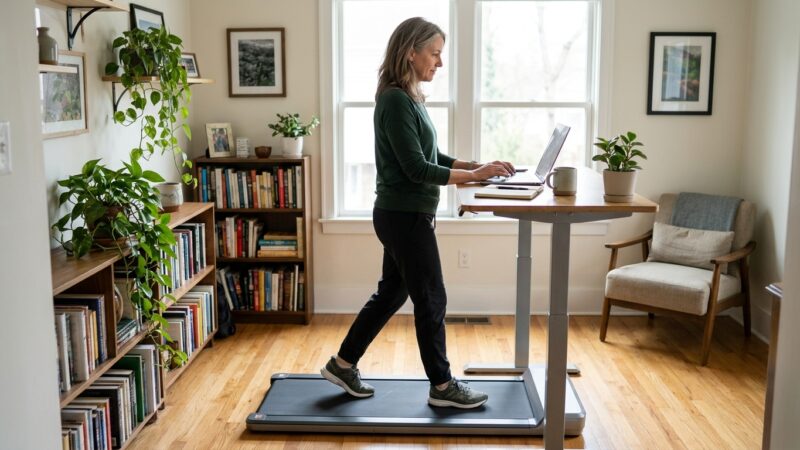
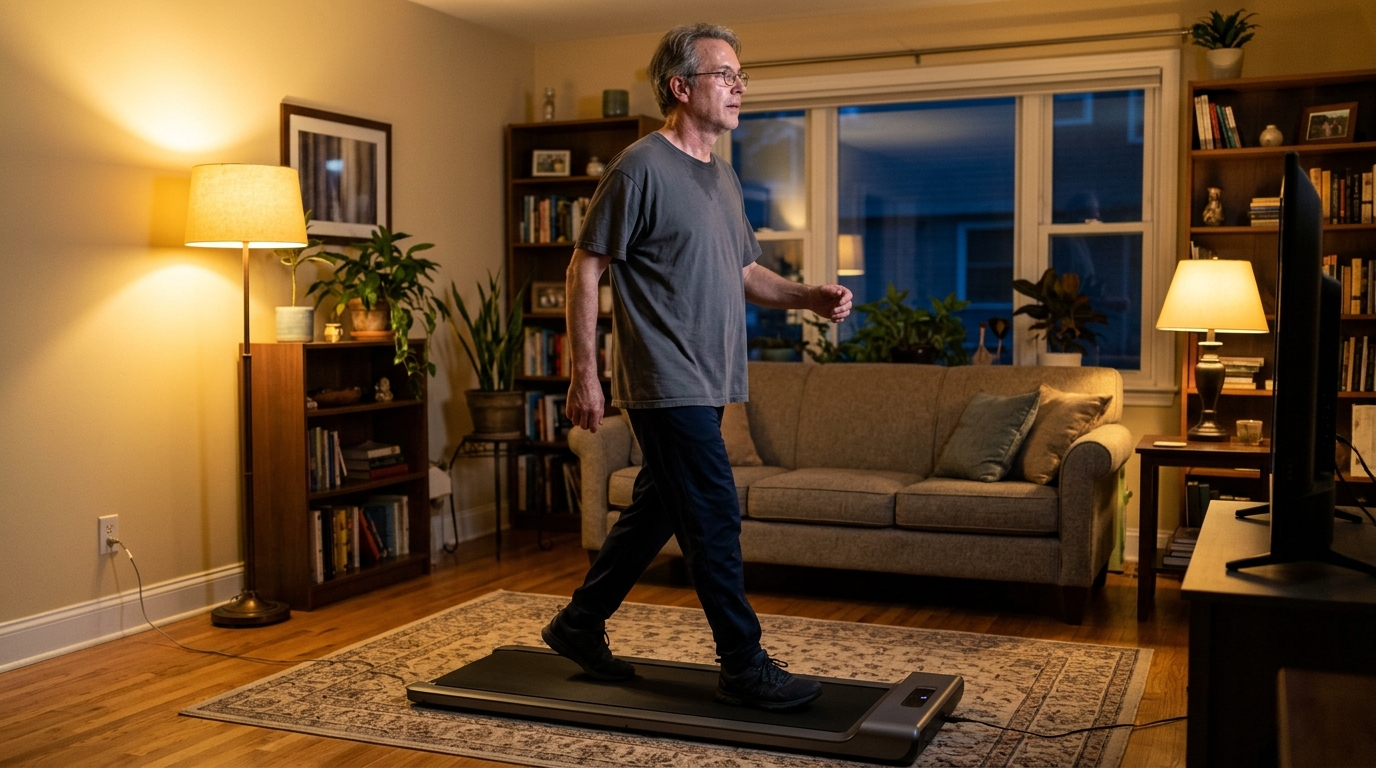
Walking pads, the slim, handrail-free treadmills that slide under a standing desk or sofa, have become one of the most searched pieces of home fitness equipment. The pitch is attractive: walk while you answer emails or watch television and lose weight without finding extra time to exercise. Some of that promise holds up. Some of it depends on maths that rarely survives real life.
This guide looks at how many extra calories slow walking actually burns, why weight loss is usually smaller than the numbers suggest, the benefits that matter more after 40, and how to use a walking pad without hurting your feet, back or work.
How many calories does a walking pad burn?
The best-known measurement comes from a 2007 study in the British Journal of Sports Medicine. Researchers measured the energy use of 15 sedentary adults with obesity while they sat at a desk and while they worked on a computer walking on a treadmill at a speed they chose. Seated work used about 72 kilocalories an hour. Walking and working at around 1.1 miles per hour used about 191, an increase of roughly 119 kilocalories an hour.
| Time walking instead of sitting | Approximate extra energy used per day | Roughly equivalent to |
|---|---|---|
| 30 minutes | About 60 kcal | A small apple |
| 1 hour | About 120 kcal | A slice of toast with butter |
| 2 hours | About 240 kcal | A chocolate bar |
The study’s authors calculated that replacing two to three hours of sitting a day could, in theory, lead to a large weight loss over a year, if nothing else about energy balance changed. That “if” is the catch.
Why real weight loss is usually smaller
Bodies and habits adjust. Several things tend to shrink the effect in daily life:
- People walk less than they plan to. Two hours a day sounds easy in the shop. In practice, tasks that need concentration, phone calls and tired legs mean many people settle at 30 to 60 minutes.
- Appetite can rise. Moving more can make you hungrier, and a snack can quietly cancel an hour of slow walking.
- Other movement may drop. Some people feel they have done their exercise and skip a walk or a class later.
- Slow speeds burn less. The extra calories depend on speed and body size. A strolling pace of 1 mph does less than a brisk walk.
So a walking pad is best thought of as a steady, modest boost to daily energy use rather than a weight-loss machine. Combined with eating changes, that modest boost can matter. On its own, without any change to food, it is unlikely to produce dramatic results.
The benefits that matter more than calories
For many people over 40, the bigger win is breaking up long stretches of sitting. The NHS physical activity guidelines advise adults to reduce time spent sitting or lying down and break up long periods of not moving, alongside 150 minutes of moderate activity a week and muscle strengthening on at least two days. Our guide to the health risks of sitting all day explains why long, unbroken sitting is a problem in its own right.
There is also evidence that people who have treadmill workstations simply move more. A 12-month study of office workers published in PLOS One found that daily physical activity increased after employees were given treadmill desks, and that their self-rated and supervisor-rated work performance improved rather than suffered.
A short walk after a meal is another good use. Light walking after eating helps muscles take up glucose, which smooths the rise in blood sugar. Our article on walking after meals covers how much difference it makes.
Does it count as exercise?
Slow walking while typing is light activity. It helps, but it usually does not count towards the NHS target of 150 minutes of moderate activity, which means a pace that raises your heart rate and makes you breathe faster while still being able to talk. A brisk session on the walking pad, without a laptop, can count. For a guide to the right effort level, see our article on zone 2 cardio for beginners.
It also does not replace strength training, which becomes more important with age for muscle, bone and balance. A walking pad works best as one part of a week that also includes the kind of exercises in our strength training after 50 plan.
How to use a walking pad well
- Start short. Begin with 15 to 20 minutes a few times a day and build up over a couple of weeks. Feet, shins and hips need time to adjust to long periods on a moving belt.
- Keep the pace slow when working. Around 1 to 2 mph lets most people type and read. Save brisk walking for times you are not concentrating.
- Set the desk height correctly. Your elbows should be at roughly 90 degrees and the screen at eye level, or you swap a sitting problem for a neck and shoulder problem.
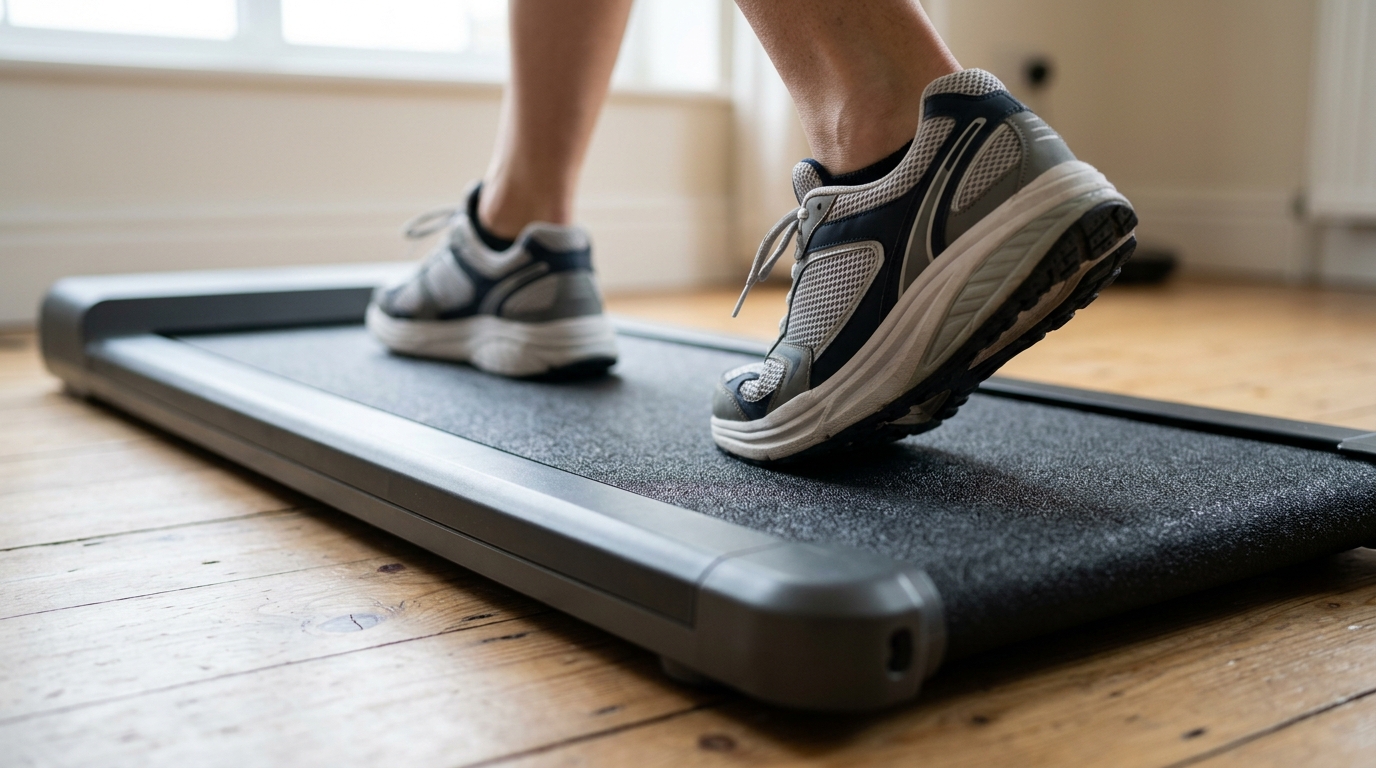
- Wear supportive shoes. Walking in socks or slippers for hours is hard on the feet.
- Use it in chunks. Several short walks spread through the day break up sitting more effectively than one long session.
Safety after 50
Most walking pads have no handrails, which matters if your balance is not what it was. Check the emergency stop key or remote before you start, keep the belt clear of cables and pets, and step on and off with the belt stopped. If you have problems with balance, dizziness, joint pain or a heart condition, a treadmill with handrails, or a walk outdoors, may be a safer choice. Check with your GP if you have been inactive for a long time and have a long-term health condition.
Is a walking pad worth buying?
It is worth it if you spend long hours at a desk or in front of the television, find it hard to fit in walks, and will actually use it most days. It is less useful if you already walk regularly outdoors, or if bad weather is not what stops you moving. Outdoor walking brings daylight, varied terrain and fresh air that a belt cannot match.
Questions people ask
How long should I walk on a walking pad to lose weight?
There is no fixed number, because weight loss depends on food as well. Replacing an hour of sitting with slow walking uses roughly 100 to 120 extra kilocalories for an average adult. Combined with modest eating changes, an hour or more a day can support gradual weight loss.
Is 10,000 steps on a walking pad as good as walking outside?
For energy use, steps are steps at the same pace. Outdoor walking adds uneven ground, hills and daylight, which help balance, muscles and sleep, so mix both if you can.
Can I use a walking pad every day?
Yes, once your feet and legs are used to it. Build up gradually, and take rest days if you notice persistent foot, shin or knee pain.
Will walking while working hurt my productivity?
For most people, not at slow speeds. The 12-month PLOS One study found work performance improved after treadmill desks were introduced. Detailed tasks are easier when standing still or sitting.
Sources
- Levine JA, Miller JM. The energy expenditure of using a “walk-and-work” desk for office workers with obesity. British Journal of Sports Medicine, 2007
- Ben-Ner A et al. Treadmill workstations: the effects of walking while working on physical activity and work performance. PLOS One, 2014
- NHS: Physical activity guidelines for adults aged 19 to 64
Sources checked 17 November 2026.