

Wireless earbuds spend hours a day inside the ear canal, a few centimetres from the brain, and they are constantly sending and receiving signals. It is a reasonable thing to wonder about. Social media posts claiming that earbuds “beam radiation into your head” have made the question more pressing for many people.
This guide explains what kind of radiation wireless earbuds give off, how much compared with a phone, what radiation protection agencies conclude, and what you can do if you would still rather keep exposure as low as possible.
- What kind of radiation do Bluetooth earbuds use?
- How much radiation do wireless earbuds give off?
- What the research and safety agencies say
- Where the viral warnings come from
- The real risks of earbuds are about hearing and hygiene
- How to reduce exposure if you still want to
- How safety limits work
- Questions people ask
- Sources
What kind of radiation do Bluetooth earbuds use?
The word “radiation” covers a huge range of energy. At one end are X-rays and gamma rays, which carry enough energy to knock electrons out of atoms and damage DNA directly. This is called ionising radiation, and it is the kind measured in the millisieverts and grays used for medical scans.
Bluetooth sits at the other end. It uses radio waves at around 2.4 gigahertz, the same band as many Wi-Fi routers. Radio waves are non-ionising: each packet of energy is far too small to break chemical bonds or damage DNA in the way X-rays can. The only established biological effect of radio waves is heating, and that requires much higher power than an earbud produces.
| Source | Type of radiation | Can it damage DNA directly? |
|---|---|---|
| Medical X-ray or CT scan | Ionising | Yes, which is why doses are tracked |
| Radon gas at home | Ionising | Yes |
| Sunlight (UV) | Borderline; UV-B damages skin DNA | Yes, in skin |
| Mobile phone | Non-ionising radio waves | No |
| Wi-Fi router | Non-ionising radio waves | No |
| Bluetooth earbuds | Non-ionising radio waves at low power | No |
How much radiation do wireless earbuds give off?
Very little, and the reason is simple physics. A phone has to reach a mast that may be several kilometres away, so it transmits at relatively high power, and turns that power up when the signal is weak. An earbud only has to reach the phone in your pocket or bag, a metre or so away.
The Australian Radiation Protection and Nuclear Safety Agency (ARPANSA) makes exactly this point in its guidance on wearable devices. Bluetooth uses low-power radio waves to connect devices that are close together, and because the signal travels such a short distance, less power is used and exposure is low. ARPANSA adds that earbuds and smartwatches must still meet the same exposure limits as other wireless devices before they can be sold.
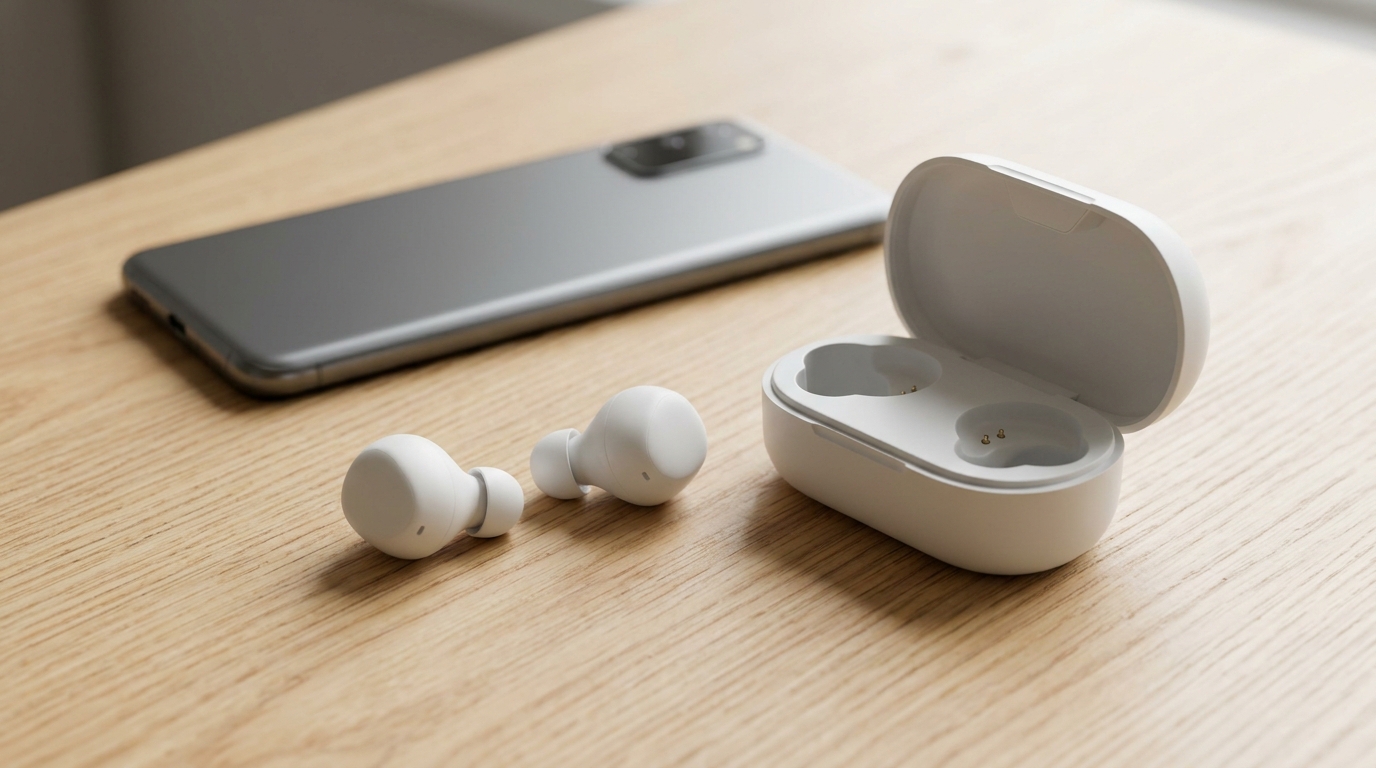
This leads to a point many people find surprising. Holding a phone against your ear for a call usually means more radio-frequency exposure to the head than talking through earbuds, because the phone, the stronger transmitter, is then kept away from your head. The earbud adds a small amount of exposure; moving the phone away removes a larger amount.
What the research and safety agencies say
There is little research specific to earbuds, which ARPANSA acknowledges. But earbuds use the same kind of radio waves as phones, and phones are one of the most studied health questions of the last thirty years.
In 2024, a systematic review commissioned by the World Health Organization looked at more than 5,000 studies published between 1994 and 2022 and found no association between mobile phone use and head cancers. The review’s lead author noted that although wireless technology use has risen enormously over the past twenty years, brain cancer rates have not risen with it. Our guide to whether cell phones cause cancer looks at that evidence in more detail.
You may also see that the International Agency for Research on Cancer classed radio-frequency fields as “possibly carcinogenic” in 2011. That category reflects limited evidence, mainly from older observational studies, and the later, much larger body of research is what the 2024 review assessed. ARPANSA’s overall conclusion on wearables is that there is no substantiated scientific evidence of health effects from the radio waves they produce.
Where the viral warnings come from
Posts warning that scientists have called earbuds dangerous usually trace back to a general petition about wireless radiation signed by a group of researchers, not to a study of earbuds. The petition did not measure earbud exposure or produce new evidence. Headlines then attached it to a popular product, and the claim has circulated ever since.
A useful rule of thumb with radiation scares is to ask two questions: what type of radiation is it, and how much? For earbuds the answers are non-ionising and very low. That does not make every concern foolish, but it does put earbuds near the bottom of the list of radiation sources worth thinking about. If you want to see where your real dose comes from, our guide to everyday radiation exposure puts radon, medical imaging and flights in context.
The real risks of earbuds are about hearing and hygiene
If you use earbuds for hours every day, two other issues deserve more attention than radio waves.
- Volume. Sound delivered straight into the ear canal, often to drown out traffic or a train, is a common cause of noise-related hearing damage. Noise-cancelling models let you listen at lower volume. Many phones can show your listening levels and warn you when they are high.
- Ear hygiene. Earbuds trap warmth and moisture and can push wax deeper. Wipe the tips regularly, do not share them, and give your ears breaks. See a pharmacist or GP if you notice pain, itching, discharge or muffled hearing.
- Awareness. Earbuds while walking, cycling or crossing roads reduce your awareness of traffic, a far more immediate risk than anything about the signal.
How to reduce exposure if you still want to
Exposure from earbuds is already low, but if you prefer to keep it as low as possible, these steps cost nothing:
- Use a wired headset for long calls. It removes the earbud transmitter entirely and keeps the phone away from your head.
- Take earbuds out when you are not listening. Many people wear them for hours out of habit.
- Use speakerphone at home. It keeps both the phone and any headset away from your head.
- Make calls where the signal is good. Phones transmit at higher power when reception is weak, so a strong signal means lower exposure from the phone.

How safety limits work
Radio-frequency exposure limits are set well below the level at which any heating effect has been seen, with a large safety margin built in. ARPANSA describes its standard as designed to protect people of all ages and health conditions against all known adverse health effects. Regulators require earbuds, phones and smartwatches to be tested against these limits before sale. Our explainer on safe radiation limits explains how safety margins work for both ionising and non-ionising radiation.
Questions people ask
Do AirPods give off more radiation than a phone?
No. Wireless earbuds, including AirPods, transmit at much lower power than a phone because they only need to reach a device nearby. Using earbuds for a call usually means less exposure to the head than holding the phone to your ear.
Is it safe to sleep with wireless earbuds in?
Radio waves are not the main concern. Sleeping in earbuds can irritate the ear canal, trap moisture and cause discomfort, and loud audio overnight adds to noise exposure. Soft sleep earbuds or a pillow speaker at low volume are kinder options.
Are wired headphones safer than wireless ones?
Wired headphones do not transmit radio waves, so they reduce exposure to zero from the headset itself. Both types are considered safe; wired is simply the choice if you want the lowest possible exposure.
Are Bluetooth earbuds safe for children?
ARPANSA notes that exposure limits are designed to protect people of all ages. For children, the more practical issue is volume. Headphones with a volume limit help protect developing hearing.
Sources
- ARPANSA: Wearable devices
- ARPANSA: WHO review finds no link between mobile phone use and brain cancer (2024)
Sources checked 17 November 2026.