Radiation units are where most people get lost. A news story mentions millisieverts, an old textbook talks about rads, a forum post quotes a Geiger counter reading in counts per minute, and someone online asks whether 3,000 rads is a lot. These are not interchangeable numbers. Each unit answers a different question, and mixing them up is the fastest way to be either frightened by something harmless or relaxed about something that matters.
This guide explains the radiation units you are most likely to meet, what each one actually measures, how to convert between the old American units and the international ones, and how to put a number in context. If you already know the units and want the numbers side by side, our guide to how much radiation is too much puts everyday doses and legal limits on one ladder.
- Radiation units answer four different questions
- Becquerel and curie: how active a source is
- Roentgen: exposure in air, mostly a historical unit
- Gray and rad: energy absorbed by tissue
- Sievert and rem: the units that describe health risk
- A radiation unit conversion table you can use
- Counts per minute: why a Geiger counter reading is not a dose
- Dose versus dose rate: the detail that changes everything
- Common mistakes when reading radiation numbers
- Questions people ask
- Sources
Radiation units answer four different questions
The easiest way to keep radiation units straight is to ask what the number is describing. There are four separate ideas, and each has an older unit still used in the United States and a newer international (SI) unit used almost everywhere else. The US Nuclear Regulatory Commission sets out the same four groups in its explainer on measuring radiation.
| Question being answered | Older unit | SI unit | Plain meaning |
|---|---|---|---|
| How radioactive is the source? | curie (Ci) | becquerel (Bq) | How many atoms decay each second |
| How much ionisation does the beam cause in air? | roentgen (R) | coulomb per kilogram (C/kg) | Exposure from X-rays or gamma rays |
| How much energy did the body absorb? | rad | gray (Gy) | Absorbed dose |
| How much biological harm could that dose cause? | rem | sievert (Sv) | Equivalent or effective dose |
Only the last row is designed to say something about risk to a person. A becquerel describes the source, not you. A roentgen describes what happens in air. A gray tells you how much energy landed in tissue. The sievert, and its older cousin the rem, adjusts that energy for the type of radiation and the parts of the body exposed, which is why doctors, regulators and medical physicists compare doses in millisieverts.
Becquerel and curie: how active a source is
One becquerel is one radioactive decay per second. That is a tiny amount of activity, so real figures tend to run into thousands or millions. The curie is the older, much larger unit: one curie equals 37 billion becquerels (3.7 × 10¹⁰ Bq), originally based on the activity of one gram of radium.
Activity on its own says nothing about dose. A source with high activity sitting behind thick shielding several metres away may give you almost nothing, while a small amount swallowed or breathed in can matter more because it stays close to tissue. That is why food and water limits are written in becquerels per kilogram or per litre: they describe how much radioactive material is present, which is the first step towards working out a dose.
Roentgen: exposure in air, mostly a historical unit
The roentgen measures how much ionisation X-rays or gamma rays produce in a given mass of air. It was the workhorse of early radiology and civil defence, which is why it still turns up in old documents, films and questions such as “how much roentgen is safe for humans”. Its SI replacement, the coulomb per kilogram, is rarely used outside specialist work.
For practical purposes with X-rays and gamma rays, the NRC treats 1 roentgen, 1 rad and 1 rem as roughly equal. That shortcut is fine for a rough sense of scale, but it does not hold for every type of radiation or every energy, so it should not be used for precise work.

Gray and rad: energy absorbed by tissue
Absorbed dose is the amount of radiation energy deposited in each kilogram of tissue. One gray is one joule per kilogram. The rad is the older unit, and the conversion is simple: 1 gray equals 100 rad, so 1 rad equals 10 milligray. Stanford University’s radiation safety guidance for hospital staff lists the same conversions in its page on units of radiation exposure.
The gray is the unit used in radiotherapy and in radiation emergencies, where the concern is direct tissue damage rather than long-term cancer risk. This is where the frightening searches come from. A person reading that a cancer patient received 60 Gy, or 6,000 rads, may wonder how anyone survives it. The answer is that radiotherapy targets a small volume of the body and splits the dose into many small daily fractions, so healthy tissue has time to repair between sessions. The same total dose delivered to the whole body at once would be fatal.
What 3,000 rads would mean
3,000 rads is 30 gray. As a rapid whole-body dose, that is far beyond survivable. The US Centers for Disease Control and Prevention describes acute radiation syndrome as beginning above about 0.7 Gy (70 rads), with half of people expected to die within 60 days at around 2.5 to 5 Gy without treatment, and gastrointestinal damage dominating above about 10 Gy, according to its clinical guidance on acute radiation syndrome. Doses like these arise only in serious accidents or deliberate attacks. They have nothing to do with scans, flights or everyday life, where the numbers are measured in thousandths of a sievert.
Sievert and rem: the units that describe health risk
Not all radiation does the same damage per unit of energy. Alpha particles deposit their energy in a short, dense track and are far more damaging inside the body than the same absorbed dose of X-rays. Equivalent dose accounts for this by multiplying absorbed dose by a radiation weighting factor: 1 for X-rays, gamma rays and beta particles, and 20 for alpha particles, with neutrons in between depending on their energy.
Effective dose goes one step further. It weights each organ by how sensitive it is to radiation-induced cancer and adds them up, giving a single number for the whole body. When you read that a chest CT gives about 6 millisieverts, that is an effective dose. It lets a CT scan, a flight and a year of natural background be compared on one scale, even though each exposes the body differently.
The conversions are: 1 sievert equals 100 rem, so 1 rem equals 10 millisieverts and 1 millirem (mrem) equals 10 microsieverts. Because whole sieverts are large, everyday figures use millisieverts (mSv, a thousandth) and microsieverts (µSv, a millionth).
A radiation unit conversion table you can use
| If you see | It equals | Rough everyday comparison |
|---|---|---|
| 1 mrem | 0.01 mSv (10 µSv) | A few days of natural background, or less |
| 100 mrem | 1 mSv | The usual annual limit for members of the public from licensed sources |
| 1 rem | 10 mSv | A few years of natural background in most places |
| 5 rem | 50 mSv | The annual limit for radiation workers in the United States |
| 1 rad | 10 mGy | About 10 mSv for X-rays and gamma rays |
| 100 rad | 1 Gy | Enough to cause radiation sickness if received all at once to the whole body |
| 1 Ci | 37 billion Bq | Describes a source, not a dose |
Two worked examples show how this helps. Someone asking “how much mrem is dangerous” can divide by 100 to get millisieverts: 500 mrem is 5 mSv, which is in the range of a single CT scan of the abdomen and well below the level where any short-term harm occurs. Our guide to CT scan safety lists typical doses by scan type. Going the other way, a dose of 0.1 mSv from a chest X-ray is 10 mrem.
Counts per minute: why a Geiger counter reading is not a dose
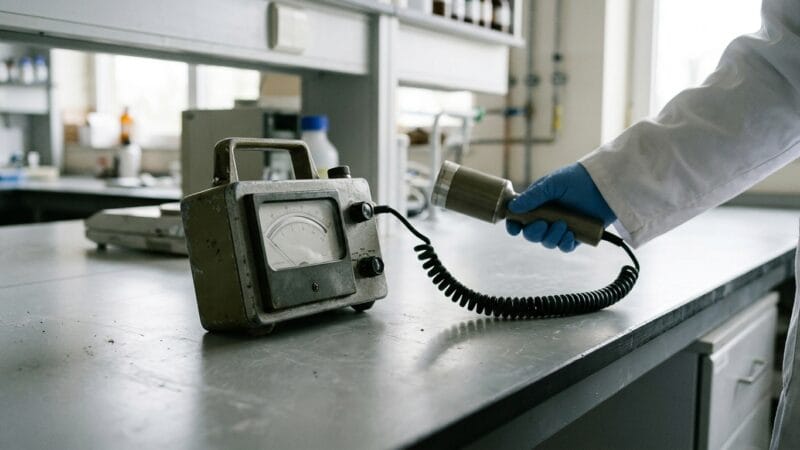
Counts per minute, or CPM, is the number of radiation events a detector registered in a minute. It describes what the instrument saw, not what your body received. Two different meters held in the same spot can give very different CPM readings because their detectors differ in size and efficiency, a point Stanford’s guidance makes directly.
Converting CPM to a dose rate needs a calibration factor for that specific detector and a known radiation energy. An expert answering a question for the Health Physics Society gives a typical figure of about 3,500 CPM per milliroentgen per hour for a common pancake-style Geiger-Müller probe measuring caesium-137 gamma rays, and stresses that the factor changes with energy and conditions, in its Ask the Experts answer on survey meter readings. Using a single conversion for every situation gives rough estimates at best.
So a question such as “how many CPM of radiation is dangerous” has no single answer. A sensible approach for a consumer meter is to note the background reading where you live, which is usually a few dozen counts per minute on common handheld devices, and treat a large and sustained rise above that as a reason to stop, step away and seek expert advice rather than as a dose in its own right. Many modern meters also display microsieverts per hour, which is more useful, as long as the device has been calibrated for the radiation you are measuring.

Dose versus dose rate: the detail that changes everything
A dose is a total. A dose rate is how quickly that total builds up, written per hour or per year. Natural background is typically below 0.2 microsieverts per hour, which adds up to a few millisieverts over a year. A reading of 1 microsievert per hour sounds five times higher, but it only matters in proportion to how long you spend there. Ten minutes at that rate adds less than a fifth of a microsievert.
The body also responds differently to a dose received in seconds compared with the same dose spread over years. Acute radiation sickness requires a large dose delivered quickly. The small doses from medical imaging, flying and natural sources are associated only with a small possible increase in long-term cancer risk, which is estimated rather than directly measured at these levels. Our explainer on everyday radiation exposure shows where a typical year’s dose comes from.
Common mistakes when reading radiation numbers
- Mixing up milli and micro. A millisievert is a thousand times a microsievert. Misreading µSv as mSv inflates a number a thousandfold, and this is the single most common error in online discussions.
- Treating activity as dose. A food test result in becquerels per kilogram tells you what is in the food, not what eating it would do. Working out a dose requires knowing which radionuclide it is and how much you would eat.
- Comparing a rate with a total. Microsieverts per hour and millisieverts per year cannot be compared until one is converted into the other using time.
- Reading radiotherapy doses as whole-body doses. Tens of gray aimed at a tumour in small daily fractions is a different situation from the same number received by the whole body in one event.
- Applying ionising radiation units to radio waves. Phones, Wi-Fi and 5G emit non-ionising radiation measured in watts per kilogram or power density, not sieverts. Our article on whether cell phones cause cancer explains the difference.
Questions people ask
How many millisieverts are in a rem?
One rem equals 10 millisieverts. To turn millirem into millisieverts, divide by 100.
Is a gray the same as a sievert?
For X-rays and gamma rays the numbers are about the same, because their weighting factor is 1. They measure different things, though. The gray is energy absorbed; the sievert estimates biological effect, and for alpha particles the sievert figure is many times larger than the gray figure.
Why does the United States still use rem and rad?
Many US regulations were written in the older units and still use them, often alongside SI units. Most other countries and international bodies use gray and sievert.
What reading should worry me on a home Geiger counter?
There is no universal threshold in counts per minute. Compare against your own background reading. A sustained, large increase is a reason to leave the area and contact your local radiation protection authority, not to calculate a dose yourself.
Sources
- US Nuclear Regulatory Commission: Measuring radiation
- Stanford Environmental Health and Safety: What are the units of radiation exposure?
- Health Physics Society: Ask the Experts, converting survey meter readings
- CDC: Acute radiation syndrome, clinical guidance
Sources checked 4 November 2026.