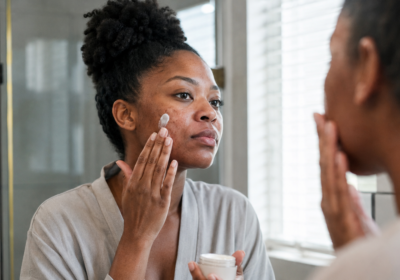
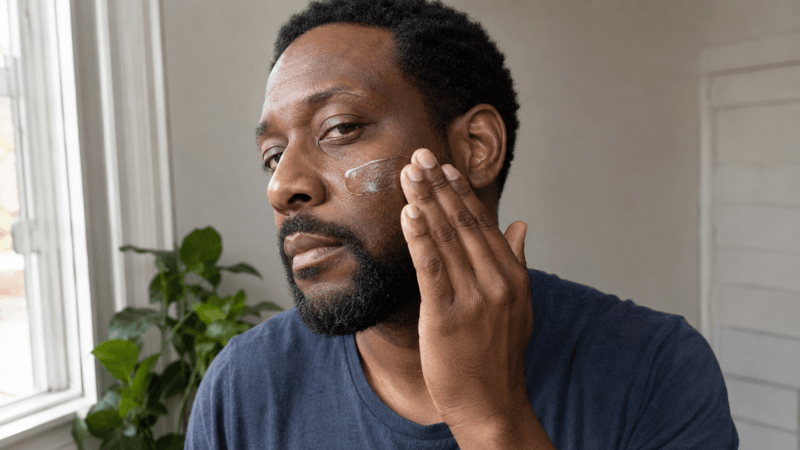
The best sunscreen for dark skin with no white cast is not a universal brand. It is a broad spectrum product you can apply in an adequate amount without leaving a finish that makes you avoid wearing it.
Melanin provides some natural protection, but darker skin can still develop sunburn, photoageing and skin cancer. Sunlight and visible light can also worsen certain pigment conditions. Protection matters; the formula has to be usable.
- Sunscreen for Dark Skin: Why Some Formulas Leave a Cast
- What to look for on the label
- How to test a sunscreen before committing
- Application without the chalky buildup
- How much, and why under-applying is the real problem
- Where the cast shows up worst
- Sunscreen is not the only barrier
- Frequently asked questions
- Matching a tint to your undertone
- Mineral and organic filters, without the scare words
- Facial hair and the hairline
- Reapplying over makeup
- Myths that keep circulating
- Planning protection for a full outdoor day
- Comfort is part of effectiveness
Sunscreen for Dark Skin: Why Some Formulas Leave a Cast
Mineral filters such as zinc oxide and titanium dioxide are particles that can scatter visible light, producing a pale cast especially when the formula is thick or not well dispersed. Organic filter formulas are often more transparent, although they may sting some eyes or skin. “Mineral” is not automatically safer, and “chemical” does not mean toxic.
What to look for on the label
- Broad spectrum: indicates protection across UVA and UVB.
- SPF 30 or higher: a common dermatologist recommendation for routine outdoor protection.
- Water resistance: useful for sweating or swimming; note the labelled duration.
- Fragrance free: may suit reactive skin, though no formula is irritation proof.
- Tint or iron oxides: can offset a white cast and may add visible light protection relevant to hyperpigmentation.
The American Academy of Dermatology recommends tinted sunscreen containing iron oxide for people managing dark spots, alongside broad spectrum SPF 30 or higher and water resistance.
It is worth knowing that the jump from SPF 30 to SPF 50 buys less than the numbers imply. The scale is not linear, and the difference in the proportion of UVB filtered between the two is small, particularly when set against the much larger effect of how much you apply and whether you reapply. A higher number is not wasted, but it is a smaller upgrade than doubling suggests, and it is not a reason to accept a formula you will not wear properly.
How to test a sunscreen before committing
Try it on the jaw, hairline and around facial hair in daylight, not only under a shop’s artificial lighting. Let it settle for ten minutes before judging the finish. Check for pilling over your moisturiser and stinging around the eyes. If possible, buy a smaller size first.
Application without the chalky buildup
Apply in two thinner, even layers rather than one thick blob, but do not reduce the total amount simply to hide the cast. Blend to the ears, hairline and neck. Allow skincare beneath it to settle. If a formula remains visibly unsuitable at the labelled amount, choose a different product rather than under applying.
How much, and why under-applying is the real problem
The quantity used in testing to establish an SPF figure is considerably more than most people apply in real life. Rough practical guides put it at around a quarter of a teaspoon for the face, or roughly the length of your index and middle fingers squeezed out, with about a teaspoon for face and neck together. These are approximations rather than precise doses, but they are far more than a quick dab.
This is where the white cast problem does its real damage, and it is rarely discussed honestly. Faced with a formula that looks grey at the proper amount, most people do not switch products. They quietly use less. The cast disappears, the product becomes wearable, and the protection quietly drops well below what the label promised.
Under-application does not reduce protection in a neat proportional way either. Using half the amount does not reliably give you half the SPF. So a person diligently applying an SPF 50 every morning at a third of the tested amount may be getting far less than the number on the bottle suggests, while believing they are well covered.
That is why the advice throughout this article is to change the formula rather than the dose. A cosmetically acceptable SPF 30 applied properly will usually serve you better than an SPF 50 you have to ration to make wearable. The best sunscreen really is the one you will apply at full strength.
Where the cast shows up worst
Cast is rarely uniform. It collects where the product cannot spread thinly: along the hairline, in the brows, through beard hair, in the creases beside the nostrils and around the ears. These are also the spots people skip, which is unfortunate, because ears and hairline are common sites of sun damage.
Working in small sections helps more than trying to cover everything in one pass. Press the product in around hair rather than dragging it across, and smooth in the direction the hair grows. A more fluid formula distributes through these areas far more easily than a thick cream, which is worth weighing when choosing between two otherwise similar products.
Do not solve the problem by mixing sunscreen into moisturiser or foundation to thin it out. Diluting it disrupts the even film the protection depends on and makes the applied dose impossible to judge. If a formula cannot be worn at the right amount without visible residue, that is information about the formula, not a technique to work around.
Reapply during continued exposure, particularly after sweating, swimming or towelling. The FDA’s sunscreen guidance advises reapplication at least every two hours during exposure, with more frequent use after water or sweat.
Sunscreen is not the only barrier
Shade, tightly woven clothing, sunglasses and a broad brimmed hat reduce reliance on perfect reapplication. These measures are especially useful during intense midday sun and for people treating hyperpigmentation.
For the underlying science of barrier care, see our guide to skin ageing and protection. If sunscreen consistently irritates you, simplify the rest of your routine using our skin barrier repair steps and consider dermatology advice.
Frequently asked questions
Does dark skin need sunscreen every day?
Daily use on exposed skin is a practical approach, particularly when UV exposure is expected or you are managing pigment changes. Clothing and shade also count.
Are tinted sunscreens makeup?
They can provide cosmetic tint, but their protective claim depends on the sunscreen label and correct use. Tint alone is not sun protection.
What if every sunscreen makes me break out?
Look for a lighter, non comedogenic formula, introduce it without other new products and cleanse gently at night. Persistent acne or dermatitis warrants professional guidance.
Matching a tint to your undertone
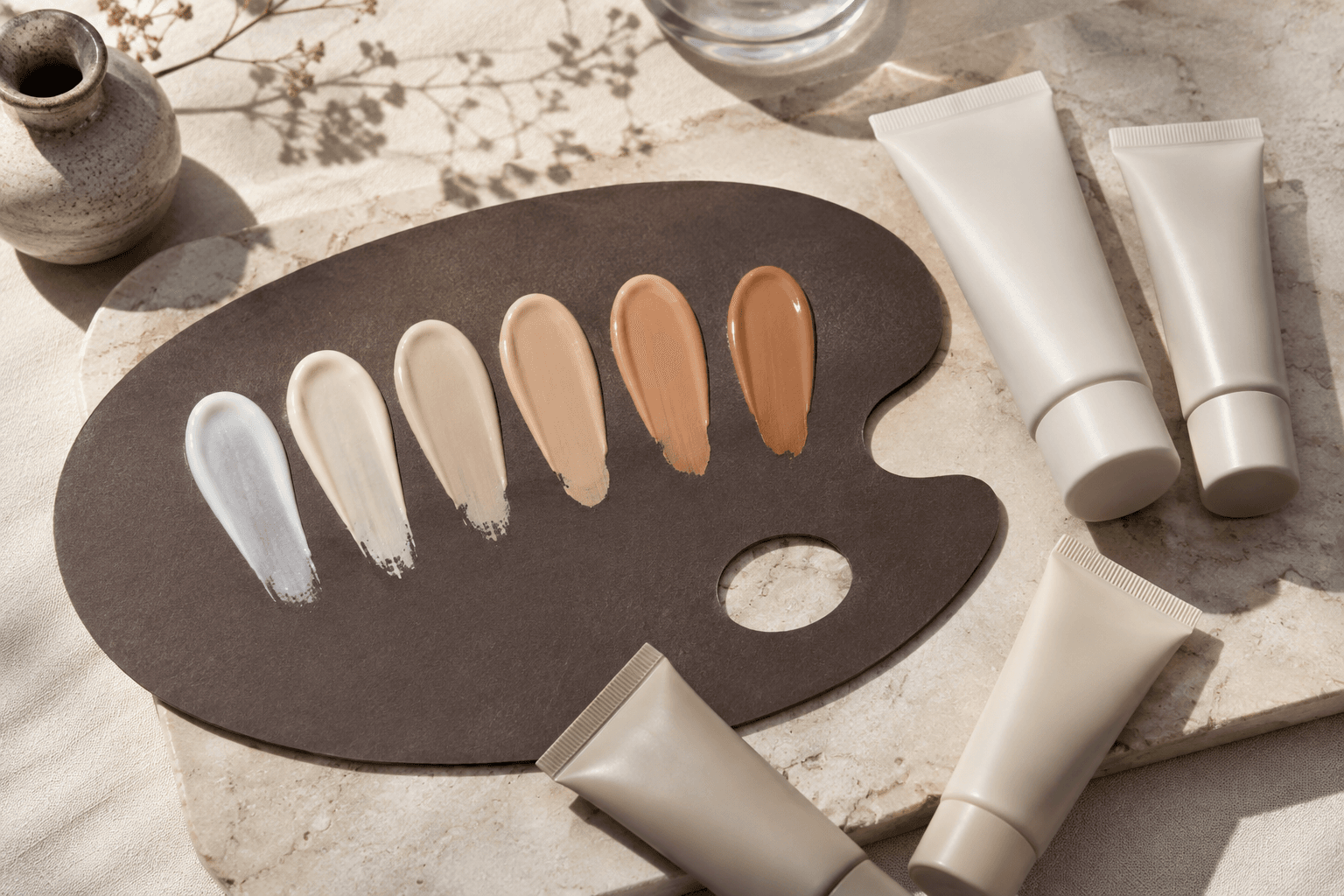
A tint can reduce a grey cast, but one shade will not suit every deep skin tone. Some formulas appear orange, pink or ashy after they dry. Test along the jaw and neck, then check the result in daylight after ten minutes.
Tinted sunscreen does not need to function as full coverage makeup. It only needs to form an even protective film with an acceptable finish. A light makeup product can be applied afterwards if desired.
Mineral and organic filters, without the scare words
Both filter groups can provide effective protection when the product is tested, labelled and used correctly. Mineral formulas often contain zinc oxide or titanium dioxide. Organic filters absorb ultraviolet energy through their chemical structures. The everyday label “chemical sunscreen” is not a useful measure of danger.
Choose based on broad spectrum protection, tolerance, finish and local regulatory labels. People with a history of allergy should review ingredients and seek advice when reactions recur.
Facial hair and the hairline
Thick formulas can collect in brows, beard hair and the hairline. Apply in small sections and press or smooth in the direction of hair growth. A more fluid product may be easier to distribute, but it still needs to be applied in the labelled amount.
Do not dilute sunscreen with moisturiser or foundation. Mixing can disrupt the protective film and makes the applied dose impossible to judge.
Reapplying over makeup
Reapplication is difficult when makeup is worn. Tapping on a compatible fluid, using a cushion designed to deliver sunscreen or redoing the protective layers may work, but powders and sprays can be difficult to apply in enough quantity as the only method.
Use hats, shade and timing to reduce direct exposure when perfect cosmetic reapplication is impractical. These measures support sunscreen rather than replace it.
Myths that keep circulating
Darker skin does not make sun damage impossible. It may reduce some ultraviolet sensitivity, but protection remains relevant for burns, ageing, pigment conditions and skin cancer. Another myth is that sunscreen blocks all vitamin D production. Real world use is imperfect, and vitamin D concerns should be addressed through clinical advice and appropriate diet or supplements when needed.
A white cast is a formulation problem, not evidence that the product protects better. Transparent or tinted products can provide labelled protection when used correctly.
Planning protection for a full outdoor day
Apply before exposure according to the label. Carry enough product for reapplication, plus a broad brimmed hat and protective clothing. Seek shade during the most intense sun when possible. Swimming and heavy sweat require a water resistant product and timely reapplication.
Do not forget ears, the back of the neck, hands and feet. Lip balm with appropriate sun protection can cover the lips. Scalp protection may require a hat or suitable product along exposed parts.
Comfort is part of effectiveness
A sunscreen that looks acceptable, feels comfortable and survives your normal day is worth more than a theoretically perfect bottle you leave in a drawer. Test the finish at a proper amount, in daylight, and then let shade, a hat and clothing carry part of the load so the sunscreen does not have to be flawless.