
A cell phone spends hours pressed against your head, a router blinks on the shelf all night, and a new mast appears at the end of the street. It is reasonable to ask: do cell phones cause cancer, and what about WiFi and 5G? The short answer, based on decades of research, is that no consistent link has been found between ordinary use of phones, WiFi or 5G and cancer. The longer answer is more interesting, because it explains why scientists are fairly confident, where honest uncertainty remains, and why one international classification is so often misread.
This article brings phones, WiFi and 5G together because they share the same physics. If you want the wider picture of where your radiation dose really comes from, our guide to everyday radiation exposure covers radon, medical imaging and the sun, and our guide to safe radiation limits puts the numbers on one scale.
- Where radio waves sit on the spectrum
- Do cell phones cause cancer? What the research shows
- Claim by claim: how strong is the evidence?
- What is actually new about 5G
- WiFi and the router by the bed
- Symptoms people link to wireless signals
- Children and pregnancy
- If you want to reduce exposure anyway
- Questions people ask
- Sources
Where radio waves sit on the spectrum
“Radiation” is a single word for a very wide range of energy. At one end are radio waves, microwaves and visible light. At the other are X-rays and gamma rays. What separates them, for health purposes, is the energy carried by each individual packet of radiation, called a photon.
X-rays and gamma rays carry enough energy per photon to knock electrons out of atoms. That process, ionisation, is how they can break chemical bonds in DNA directly. Radio waves cannot. A WiFi signal at 2.4 gigahertz carries roughly ten millionths of an electronvolt per photon. Ionising a water molecule takes around twelve electronvolts. The gap is about a million-fold, and turning up the power does not close it, because more photons of the same low energy still cannot each do what a single X-ray photon does.
What radio waves can do, at high enough intensity, is warm tissue. That is how a microwave oven works, using a sealed metal box and hundreds of watts. A cell phone transmits at a small fraction of a watt, and safety limits are built around keeping any heating trivial. In the United States, the Federal Communications Commission requires phones to stay under a specific absorption rate (SAR) of 1.6 watts per kilogram, averaged over one gram of tissue. International limits from ICNIRP, updated in 2020 to cover frequencies up to 300 gigahertz, follow the same heating-based logic with a wide safety margin.
Physics alone does not settle a health question. It tells you which mechanisms are plausible, and then you need studies of real people. That is where the evidence comes in.
Do cell phones cause cancer? What the research shows
Researchers have studied phones and cancer in three main ways: large population studies, case-control studies that compare people with brain tumours against people without, and long-term tracking of cancer rates as mobile phone use exploded.
The most comprehensive recent review was commissioned by the World Health Organization and published in Environment International in 2024. It pooled 63 studies published between 1994 and 2022 and found no association between cell phone use and cancers of the brain or head, including among people who had used phones for ten years or more and among the heaviest callers. The US National Cancer Institute reaches a similar conclusion and points to a telling detail: brain cancer rates in the population have not risen in step with the enormous growth in phone use.
Not every scientist accepts the 2024 review, and some groups have published critiques of its methods. That debate is worth knowing about. But the review’s conclusion matches the positions of the US Food and Drug Administration and most national health agencies, which have reviewed the same body of work independently.
Why IARC said “possibly carcinogenic”
In 2011 the International Agency for Research on Cancer placed radiofrequency fields in Group 2B, possibly carcinogenic to humans. The decision rested on limited evidence from case-control studies of heavy users, where people with tumours may have remembered their past phone use differently from healthy volunteers. That is recall bias, and it is a known weakness of this study design.
A Group 2B label is a statement about the strength of evidence that something could cause cancer under some circumstances. It is not a measure of how likely that is, and it says nothing about typical exposure. The label still stands, and it is a fair reason for research to continue. It is not evidence that everyday cell phone use causes tumours.
Claim by claim: how strong is the evidence?
| Claim | What the evidence shows | Our reading |
|---|---|---|
| Radio waves can break DNA the way X-rays do | Photon energy is around a million times too low | Not supported by physics |
| Strong radio-frequency fields can heat tissue | Well established; limits are set to prevent it | Established, and controlled by regulation |
| Cell phone use causes brain tumours | Large reviews find no consistent association; population rates flat | Not supported by current evidence |
| Living near a 5G mast raises cancer risk | Public exposure near masts is typically far below limits | Not supported by current evidence |
| A router in the bedroom harms sleep through its signal | Studies are mixed and low quality; screens and alerts are the clearer culprits | Uncertain, and probably not the main issue |
| Very long-term effects are fully understood | Smartphones and 5G are newer than the cohorts studied | Genuine uncertainty; research continues |
What is actually new about 5G
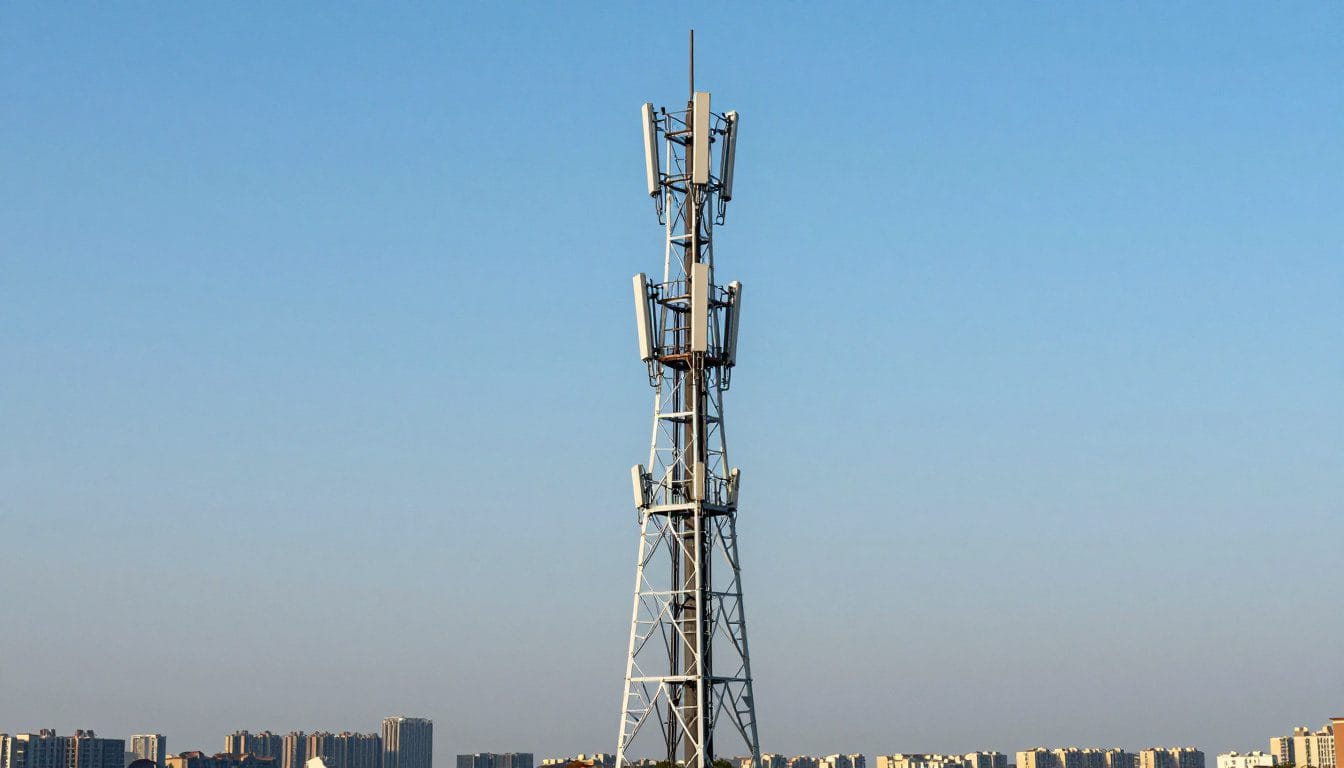
Most 5G traffic runs on frequency bands similar to those used by earlier networks. Some deployments add higher frequencies, sometimes called millimetre waves. These are still non-ionizing, and they penetrate the body less deeply than older signals, depositing their energy mainly in the outer layers of the skin. That is why research on 5G focuses on surface heating, and why current exposure guidelines include limits specific to these frequencies.
The WHO’s questions and answers on 5G state that no adverse health effect has been causally linked to wireless technologies at exposures below international guidelines. A mast looks imposing, but your personal exposure is usually dominated by the phone in your hand, not the antenna down the road. A phone working hard to reach a distant mast actually transmits at higher power than one with good signal, which is a small irony for anyone campaigning against local masts.
WiFi and the router by the bed
Home routers transmit at low power and usually sit metres away from you, so your exposure from them is typically lower than from a phone held to the ear. Exposure falls quickly with distance, so moving a router from the bedside table to a hallway shelf cuts it substantially at no cost.
If sleep is the worry, look first at what the router enables. A phone that lights up with messages at 2 a.m., a smartwatch buzzing against the wrist and late-night scrolling all have clearer effects on sleep than the signal itself. Our article on screen time and mental health covers those habits in more detail.
Switching the router off overnight is a reasonable personal choice. Before you do, check whether anything in the house depends on it: smart smoke alarms, home security, internet phone lines, or medical devices that report readings overnight.
Symptoms people link to wireless signals
Some people report headaches, tiredness, tingling or poor concentration that they attribute to phones, WiFi or masts. The symptoms are real. What controlled studies have tested is whether the signal is the cause. In double-blind experiments, where neither the participant nor the researcher knows whether a transmitter is switched on, people generally cannot tell when they are being exposed, and symptoms appear just as often with the device off.
That finding points toward other explanations, including anxiety about exposure itself, poor sleep, migraine, eye strain and stress. None of those should be dismissed. If symptoms persist, a clinician can look for causes that can be treated, which is more useful than a radiation meter.
Children and pregnancy
Children draw particular attention because they will have more years of use ahead of them and their nervous systems are still developing. Current evidence has not shown that ordinary cell phone or WiFi use causes cancer in children, and the same is true for exposure during pregnancy. Encouraging children to use speakerphone or earphones for long calls is a sensible, low-cost habit, and one that also happens to protect sleep and conversation if screens stay out of bedrooms.
If you want to reduce exposure anyway
None of these steps is medically necessary, but all of them are cheap and none carries a downside. The FCC lists similar measures.
- Use speakerphone or wired or wireless earphones for long calls.
- Text rather than call when it makes no difference to you.
- Avoid long calls where signal is weak, such as lifts or basements.
- Charge your cell phone away from your pillow.
- Place the router in a shared space rather than a bedroom.
Skip anti-radiation stickers, pendants and phone cases. The FCC does not endorse them, and a case that blocks signal can make the phone transmit harder to stay connected.
Questions people ask
Does a phone’s SAR rating tell me which phone is safer?
Not really. SAR is measured at maximum power under test conditions. In daily use, a phone’s output varies constantly with signal strength, so two phones that pass the limit can give very similar real-world exposure.
Does airplane mode stop transmission?
It switches off the cellular radio, and usually WiFi and Bluetooth unless you turn them back on. It is useful for sleep, but not needed for cancer prevention.
Is a microwave oven the same risk as a phone?
Both use non-ionizing microwave energy, but an oven is designed to concentrate hundreds of watts inside a shielded box. Use it as directed and do not operate one with a damaged door.
Sources
- Karipidis et al., Environment International (2024): RF exposure and cancer risk, systematic review
- National Cancer Institute: Cell phones and cancer risk
- FDA: Scientific evidence for cell phone safety
- IARC: Press release 208 on radiofrequency fields
- WHO: 5G mobile networks and health
- FCC: Wireless devices and health concerns
Sources checked 15 September 2026. This article is general education, not medical advice. See our editorial policy and medical disclaimer.