

Your brain gets rusty when every day runs on autopilot. The good news is that mental exercises do not need to be fancy to be useful. A few well-chosen challenges may support memory, attention, and mental speed over time, and a 2026 study on adding cognitive training to balance physiotherapy is one example of researchers testing that idea. They are not a guaranteed shield against cognitive decline, and they do not treat medical conditions, but they can be one helpful part of a brain-friendly routine.
Mental challenge works best alongside the other habits covered in our guide to brain health.
The sweet spot is simple: regular practice, a little difficulty, and enough variety to keep your mind awake.
- Mental Exercises for Better Memory: Benefits and Limits
- Why brain training apps usually disappoint
- Brain challenges you can do at home: Use puzzles that force real problem-solving
- Learn something new on purpose: Novelty wakes up attention
- Train attention, not only memory: Active reading beats passive intake
- Your brain works inside a body: Movement helps thinking
- Build a routine you will keep: Start smaller than your ambition
- When memory changes need a real conversation
- A steadier mind starts with repeatable challenge
Mental Exercises for Better Memory: Benefits and Limits
Brains adapt to use. If you spend time recalling names, solving patterns, or learning chords on a piano, you usually get better at those kinds of tasks. That is the basic idea behind many cognitive activities.
Research on brain training games has found gains on some measured skills in healthy adults. At the same time, those gains are often strongest on the exact tasks people practiced. That matters. A faster app score does not always mean a huge jump in every part of daily life.
A broader routine works better than one magic trick
Harvard Health makes a similar point in its advice on a workout for your brain. Mental challenge helps most when it sits alongside healthy daily habits.
So yes, a crossword may help you stay mentally active. No, it is not a prescription. Think of brain work as practice, not proof. The goal is to support cognitive function, keep attention engaged, and give your mind something harder than scrolling.
Why brain training apps usually disappoint
Almost everyone who has downloaded a brain training app has had the same experience. The scores climb week after week, the little progress charts go up and to the right, and yet nothing about ordinary life feels noticeably sharper. You still walk into the kitchen and forget why. That gap between the score and the life has a name. Psychologists call it transfer, and it is probably the single most useful idea to hold on to when you are deciding where to spend your practice time.
Transfer is the question of whether getting better at one task carries over to a different one. The honest summary is that it tends to carry a short distance and then stop. Practice a card-matching game and you get quicker at that card-matching game. You may also get a little quicker at a game built on almost the same mechanics, which is sometimes described as near transfer. What rarely shows up is far transfer, where drilling one narrow skill for weeks makes you better at remembering where you left your keys, following a complicated conversation at a noisy table, or picking up a task again after the phone interrupted you.
What transfer means when you choose an activity
If practice mostly improves the thing you practiced, then the sensible move is to practice things you actually want to be good at. That single rule does more work than any product comparison. It reframes the question from “which app trains the brain best” to “what do I keep struggling with, and what would rehearsing that look like?”
- If you lose names at social events, practice names. Repeat the name back, use it twice in the first minute, and test yourself on the drive home.
- If you cannot hold onto what you read, practice reading and recalling, not tapping coloured tiles.
- If following directions in an unfamiliar area rattles you, practice navigating without turn-by-turn prompts on a route you already half know.
- If conversations move too fast, get into more conversations, ideally the kind that require you to track an argument and respond.
None of this makes an app worthless. If a daily puzzle is what gets you to sit down and concentrate for 15 minutes, that is a real habit and it beats another 15 minutes of scrolling. The mistake is treating the rising score as evidence that something general has improved underneath. Read it for what it is: proof that you have gotten good at that game. Then spend most of your effort on activities that are closer to the life you want to think clearly in, because those are the ones with the shortest distance to travel.
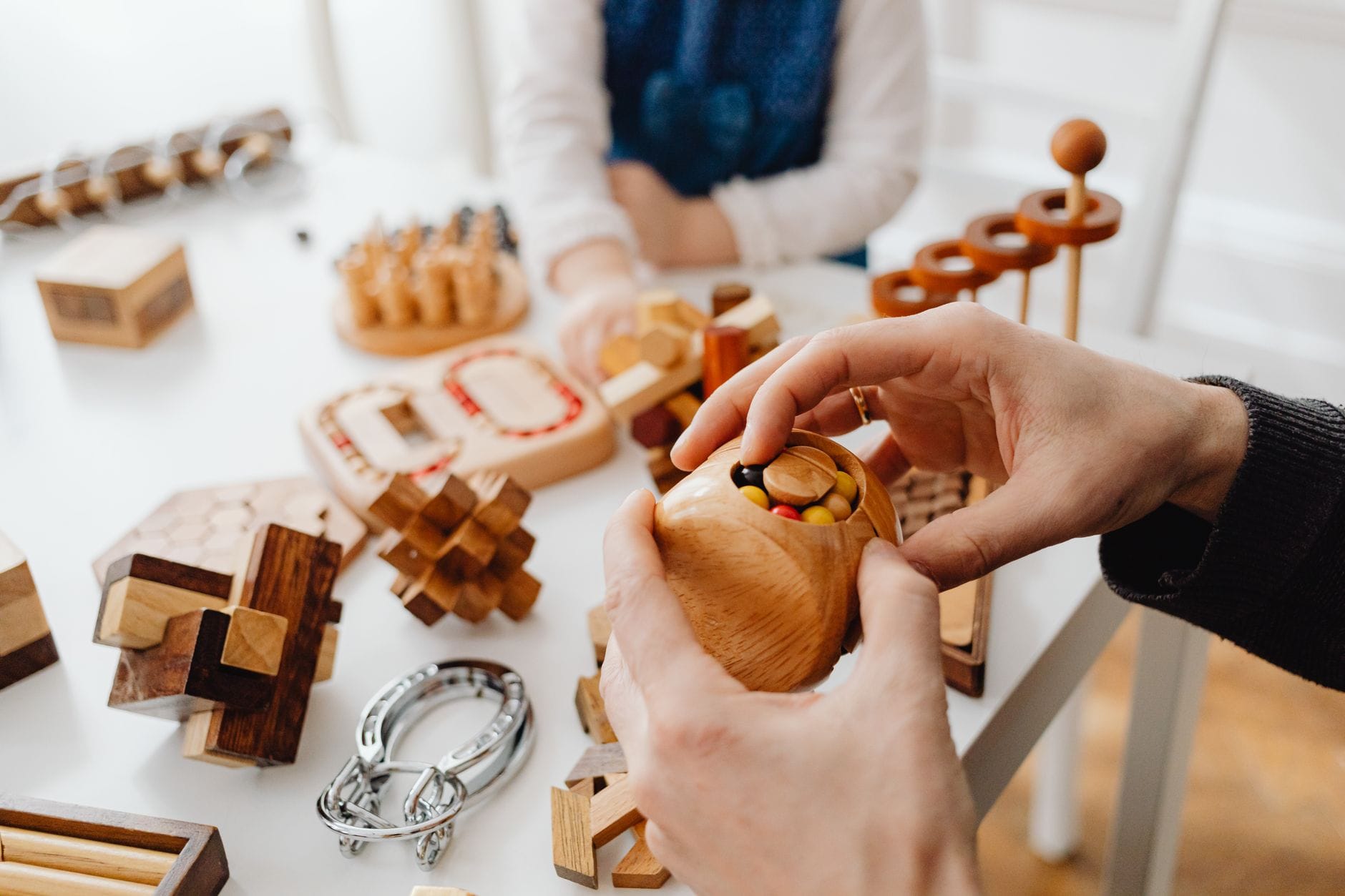
Brain challenges you can do at home: Use puzzles that force real problem-solving
Crosswords, number puzzles, logic grids, jigsaw puzzles, and card games can all work. The key is not the brand name. The key is whether the task makes you think, hold information in mind, and adjust when you get stuck.
A puzzle that is always easy stops asking much of you. A puzzle that is way too hard turns into frustration. Aim for that middle zone where you need effort, but you can still make progress.
Practice recall with your real life, not only games
Recall is different from recognition. It is easier to pick the right answer from a list than to produce it from memory. That is why at-home memory drills can be so practical.
Try remembering your grocery list before you check your phone. Read one page of a book, then say the main points out loud. Listen to a podcast for 10 minutes, then summarise it without notes. Cook a familiar meal from memory before reaching for the recipe.
Those small acts train retrieval, which is a big part of everyday thinking.
Learn something new on purpose: Novelty wakes up attention
When you learn a new skill, your brain cannot lean on habit as much. It has to pay attention, hold steps in mind, notice mistakes, and try again. That combination is useful.
Think of it like taking a new route through town. You look up more. You notice landmarks. You stop coasting.
Pick a skill with layers
A good beginner project has room to grow. That could be learning basic piano, trying a new language, sketching what you see, memorising dance steps, or following a new recipe without peeking every 30 seconds.
Start with 10 to 15 minutes. Stop before your brain feels fried. Then come back tomorrow.
Hard is good. Impossible is not.
A common mistake is repeating only what already feels smooth. Once a task becomes automatic, add one new chord, one new word list, or one harder variation.
Train attention, not only memory: Active reading beats passive intake
Plenty of adults say, “I read a page and realise I took in nothing.” That is often an attention problem before it is a memory problem.
Try reading in shorter blocks. After each section, close the book and recall three ideas. Write one sentence that explains what you read in plain language. If you cannot explain it, go back and look again.
This works because attention is the gatekeeper. If information never gets in cleanly, memory has less to work with later.
Single-task practice is a brain exercise too
Multitasking sounds productive. Most of the time, it is just fast switching. That switching eats focus.
Pick one short activity each day and do it without your phone, TV, or five open tabs. It might be balancing a checkbook, doing a word game, sorting photos, or reading an article with pen in hand. You can also try five minutes of simple mindfulness, where you keep returning attention to your breath or to sounds in the room. That does not cure memory issues, but it may help you notice when your attention slips.
Your brain works inside a body: Movement helps thinking
Mental work is stronger when the rest of you is not neglected. The CDC‘s guidance on physical activity and brain health says regular movement can help with thinking, learning, problem-solving, memory, and mood, and the WHO’s 2020 guidelines on physical activity and sedentary behaviour set out how much adults should aim for.
That does not mean you need marathon training. A brisk walk, cycling, swimming, dancing, or resistance work can all count.
Sleep, stress, and social contact matter too
A tired brain is a stubborn brain. If sleep is poor, concentration usually drops first. Chronic stress can also crowd out focus, because your mind keeps circling back to whatever feels urgent.
Social interaction helps in a different way. Conversation asks you to listen, interpret, remember details, and respond in real time. A weekly class, book club, walking partner, or game night gives the brain more than one kind of workout.

Build a routine you will keep: Start smaller than your ambition
Most routines fail because they ask for too much, too soon. Fifteen minutes, four or five days a week, is a strong start. Tie it to something you already do, like morning coffee or the time right after lunch.
You do not need seven different apps. Two or three repeating activities are enough.
Rotate tasks and track what feels sharper
Use a simple weekly rhythm. Monday might be a logic puzzle. Tuesday could be language practice. Wednesday might be a walk where you recall a short shopping list or name items in a category. Friday could be active reading with a short summary from memory.
If you want to track progress, keep it basic. Write down how long you practiced, what you did, and whether it felt easy, moderate, or hard.
The goal is consistency, not a perfect streak.
When memory changes need a real conversation
Pay attention to daily life, not only test scores
Forgetting why you walked into a room happens to almost everyone. What deserves closer attention is change that starts interfering with normal life.
Talk with a healthcare professional if memory problems are getting worse, if bills or medications are being missed, if you are getting lost in familiar places, or if other people have started noticing a change. Sudden confusion, trouble speaking, severe headache, weakness, or an abrupt memory shift needs prompt medical care.
Bring details, not guesses
It helps to bring examples. When did the change start? Is it steady or sudden? What tasks are harder now? Bring a medication list, and mention sleep problems, hearing changes, mood changes, or major stress.
That kind of detail can save time and point the visit in the right direction.
A steadier mind starts with repeatable challenge
Your brain does not need constant entertainment. It needs regular work that asks for recall, attention, problem-solving, and a little novelty.
Small sessions count. So do walks, better sleep, and conversations that make you think. Put those together, repeat them often, and you give cognitive function more support than any single puzzle ever could.