


Your 50th birthday doesn’t signal the beginning of physical decline—it marks the start of a new chapter where the right exercise habits become more important than ever. While we’ve explored the foundational principles in our guide to Healthy Aging After 50: Evidence-Based Strategies for Longevity, Strength, and Independence and examined optimal nutrition in How to Eat After 50 for Energy, Immunity, and a Longer, Healthier Life, this article focuses exclusively on the exercise strategies that will keep you strong, balanced, and independent for decades to come.
The truth is, your body after 50 responds remarkably well to exercise—sometimes even better than younger bodies in certain ways. You can build muscle, increase bone density, improve balance, boost energy, and enhance overall function at any age. The key is knowing what types of exercise matter most, how to perform them safely and effectively, and how to create sustainable habits that fit your life.
This comprehensive guide will show you exactly how to exercise after 50 to maximize strength, perfect your balance, and maintain the independence that makes life worth living.
Why Exercise Becomes Critical After 50
The Use It or Lose It Reality
After age 50, your body accelerates a process that’s been happening gradually since your 30s: sarcopenia, the loss of muscle mass and strength. Without intervention, adults lose approximately 3 to 5% of their muscle mass per decade after 30, with the rate speeding up significantly after 50. By age 80, many people have lost 30 to 40% of their muscle mass.
This isn’t just about aesthetics or fitting into your favorite jeans. Muscle mass directly correlates with independence. It determines whether you can carry groceries, climb stairs, get up from a chair without assistance, recover from illness, and maintain your metabolism. Low muscle mass is a stronger predictor of mortality than body weight or body mass index.
Here’s the empowering truth: this muscle loss isn’t inevitable. It’s largely preventable and even reversible through proper exercise. Studies show that people in their 70s, 80s, and even 90s can gain significant muscle mass and strength through resistance training. Your muscles don’t lose the ability to grow—they just need the right stimulus.
Balance and Fall Prevention
Falls represent one of the greatest threats to independence after 50. One in four adults over 65 falls each year. Many of these falls result in serious injuries like hip fractures that permanently alter quality of life and independence. Even falls without injury often create a fear of falling that causes people to restrict their activities, leading to further weakness and even higher fall risk.
The good news? Balance can be improved at any age through specific exercises. Better balance doesn’t just prevent falls—it enhances your confidence in movement, allows you to stay active and engaged in life, and supports overall physical function.
Bone Density and Osteoporosis Prevention
Bone density peaks in your 30s and gradually declines afterward, accelerating significantly for women after menopause when estrogen levels drop. Osteoporosis, a condition of dangerously low bone density, affects millions of older adults and dramatically increases fracture risk.
Weight-bearing exercise and resistance training are among the most effective interventions for maintaining and even increasing bone density. When you place stress on your bones through exercise, they respond by becoming stronger and denser. Combined with adequate nutrition as discussed in our nutrition guide for people over 50, exercise provides powerful protection against osteoporosis.
Metabolic Health and Disease Prevention
Regular exercise after 50 helps prevent or manage virtually every chronic disease that becomes more common with age. It improves insulin sensitivity and helps prevent or control type 2 diabetes. It reduces blood pressure and protects against cardiovascular disease. It supports healthy cholesterol levels, reduces chronic inflammation, and may even reduce cancer risk.
Exercise also helps maintain a healthy weight by preserving metabolically active muscle tissue and increasing the number of calories you burn throughout the day. As we explored in our comprehensive healthy aging article, physical activity works synergistically with proper nutrition to support optimal body composition.
Building Strength: The Foundation of Functional Fitness
Why Strength Training Is Non-Negotiable
If you could only do one type of exercise after 50, strength training would be the clear choice. Also called resistance training or weight training, this form of exercise involves working your muscles against resistance to build strength and muscle mass.
Strength training addresses the root cause of many age-related physical declines. It preserves and builds muscle mass, increases bone density, improves metabolism, enhances insulin sensitivity, supports joint health, improves balance and coordination, boosts mood and cognitive function, and increases confidence in your physical abilities.
The research is unequivocal: strength training is safe and effective for older adults, including those with chronic conditions like arthritis, osteoporosis, heart disease, and diabetes. In fact, these conditions often improve with proper strength training.
Getting Started with Strength Training
If you’re new to strength training, the prospect might feel intimidating. But starting is simpler than you think. You don’t need expensive equipment or a gym membership, though these can be helpful. You can begin at home with minimal equipment and progress from there.
Start with bodyweight exercises: Your body provides all the resistance you need initially. Squats, wall push-ups, standing rows using a towel wrapped around a sturdy post, and step-ups onto a low step are all effective bodyweight exercises that build functional strength.
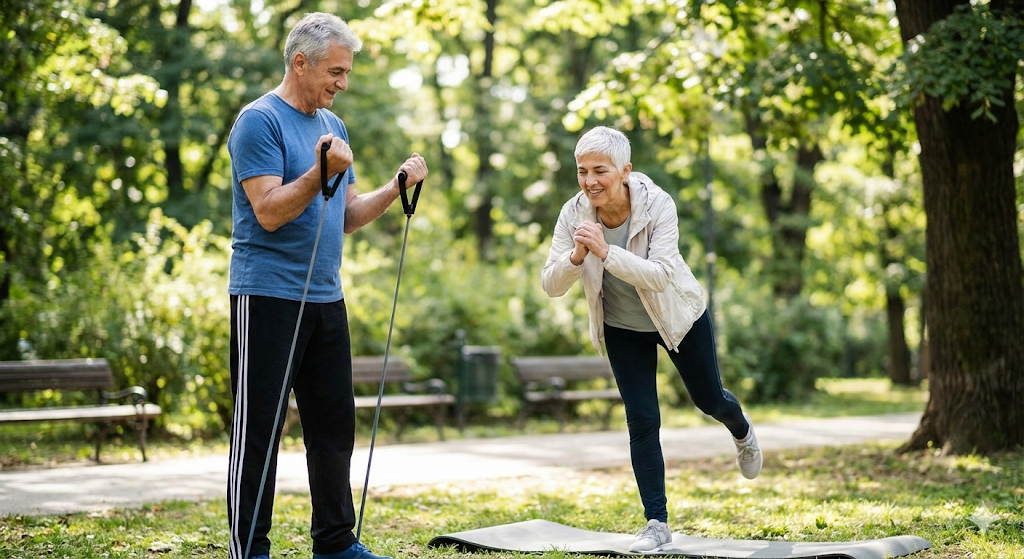
Add resistance bands: These inexpensive, portable tools provide variable resistance and are gentle on joints. They’re perfect for beginners and remain valuable even as you advance. A set of bands with different resistance levels costs less than $30 and allows hundreds of exercise variations.
Progress to dumbbells: A set of light dumbbells (start with 3-10 pounds depending on your current strength) opens up countless exercise possibilities. You can gradually increase weight as you get stronger.
Consider a gym: While not necessary, gyms provide access to more equipment, professional guidance, and a motivating environment. Many gyms offer programs specifically designed for older adults.
Essential Strength Exercises for People Over 50
Focus on compound exercises that work multiple muscle groups simultaneously and mimic real-life movements. These provide the most functional benefits for daily activities.
Squats are the king of lower body exercises. They strengthen your quadriceps, hamstrings, glutes, and core—all crucial for standing up from chairs, climbing stairs, and maintaining balance. Start with chair squats: lower yourself to a chair, lightly touch the seat, and stand back up. As you get stronger, progress to squats without the chair, then add weight.
Push-ups build upper body and core strength. Begin with wall push-ups if needed, progress to countertop or bench push-ups, and eventually to floor push-ups as you get stronger. Push-ups strengthen your chest, shoulders, triceps, and core.
Rows balance out pushing exercises by strengthening your back, biceps, and rear shoulders. You can do rows with resistance bands, dumbbells, or even filled water bottles. Rows improve posture, support shoulder health, and build the pulling strength needed for everyday tasks.
Lunges challenge balance while building leg strength. They strengthen each leg individually, addressing strength imbalances. Start with stationary lunges, holding onto a counter for balance if needed. Progress to walking lunges as your balance and strength improve.
Planks build core strength essential for all movement and protecting your lower back. Start with wall planks, progress to incline planks on a countertop, then to floor planks on your knees, and eventually to full planks. Hold the plank position for 10-30 seconds, rest, and repeat.
Deadlifts teach proper hip hinge mechanics crucial for safely lifting objects from the ground. They strengthen your entire posterior chain—glutes, hamstrings, and back muscles. Start with light dumbbells or a broomstick to learn proper form before adding significant weight.
Creating Your Strength Training Routine
For optimal results, strength train 2-3 times per week on non-consecutive days, giving your muscles time to recover and grow stronger. Each session should last 30-45 minutes and include exercises for all major muscle groups.
A simple full-body routine might include: squats (3 sets of 8-12 repetitions), push-ups (3 sets of 8-12 reps), rows (3 sets of 8-12 reps), lunges (2 sets of 8-12 reps per leg), and planks (3 sets of 10-30 seconds).
Start with weights or resistance that make the last 2-3 repetitions of each set challenging but still doable with good form. When you can complete all sets with proper form, increase the resistance or difficulty. This progressive overload principle ensures continued improvement.
Form and Safety Considerations
Proper form matters more than the amount of weight you lift, especially after 50. Poor form leads to injuries, while good form maximizes benefits and keeps you safe.
Key form principles include keeping your core engaged throughout exercises, moving through your full range of motion without pain, breathing steadily rather than holding your breath, moving with control rather than momentum, and stopping if you feel sharp pain.
Consider working with a certified personal trainer, especially when starting out. Even a few sessions can teach proper form, create a personalized program, and build your confidence. Look for trainers with experience working with older adults or certifications in senior fitness.
Improving Balance: Your Insurance Policy Against Falls
Understanding Why Balance Declines
Balance relies on the integration of three systems: your visual system, your vestibular system in your inner ear, and your proprioceptive system that senses your body’s position in space. All three systems naturally decline with age. Your reaction time slows, your muscles weaken, your joints become stiffer, and certain medications can affect balance.
The good news is that balance, like strength, improves with practice. Balance training challenges these systems, forcing them to adapt and improve. Regular balance exercises can significantly reduce your fall risk while increasing your confidence in movement.
Simple Balance Exercises You Can Do Anywhere
Balance training doesn’t require special equipment or much space. You can practice these exercises at home while holding onto a counter or sturdy chair for support initially.
Single-leg stands: Stand on one foot for 10-30 seconds, then switch legs. Start by holding onto a counter for support. As you improve, reduce your finger pressure on the counter, progress to light finger contact, then to hovering your hand near the counter without touching, and eventually to standing freely. Make it harder by closing your eyes once you can stand steadily with eyes open.
Heel-to-toe walk: Walk in a straight line, placing the heel of one foot directly in front of the toes of the other foot, like walking a tightrope. Start near a wall for support if needed. This exercise challenges both balance and coordination.
Standing marches: Stand tall and lift one knee to hip height, hold for a second, then lower and repeat with the other leg. Keep your torso upright and avoid leaning. Progress by doing this without holding onto anything.
Weight shifts: Stand with feet hip-width apart. Shift your weight to one foot, lifting the other foot slightly off the ground. Hold for a few seconds, then shift to the other side. This simulates the weight transfers that occur naturally during walking.
Backwards walking: Walking backward challenges your balance system differently than forward walking. Start by holding onto a counter and taking small steps backward. Progress to walking backward without support, ensuring you have plenty of clear space behind you.
Dynamic Balance Through Movement
Static balance exercises are important, but dynamic balance—maintaining stability while moving—is what protects you in real-world situations. Activities that build dynamic balance include:
Tai chi: This ancient Chinese practice combines slow, flowing movements with balance challenges and has been extensively studied for fall prevention. Research shows tai chi significantly reduces fall risk in older adults. Many senior centers and community centers offer tai chi classes designed for beginners.
Yoga: Yoga improves balance, flexibility, and body awareness. Many styles and classes are suitable for seniors. Look for gentle, beginner-friendly, or chair yoga classes if you’re new to the practice.
Dancing: Whether ballroom, line dancing, or just moving to music in your living room, dancing improves balance, coordination, and cardiovascular fitness while being enjoyable and social.
Agility drills: Simple drills like sidestepping, stepping over small obstacles, or practicing quick direction changes safely challenge your balance system in functional ways.
Balance Training Guidelines
Practice balance exercises daily or at least 5 days per week. Unlike strength training, balance training doesn’t require recovery days. Sessions can be brief—even 10-15 minutes provides benefits.
Always practice in a safe environment near stable support and on a non-slip surface. Clear the area of obstacles that could cause tripping. Consider practicing over a carpet or mat for added cushioning if you lose balance.
Challenge yourself progressively but never to the point where you feel unsafe. The goal is to gently push beyond your comfort zone while maintaining control. If an exercise feels too difficult, reduce the challenge and build up gradually.
Cardiovascular Exercise: Keeping Your Heart and Mind Healthy
Why Cardio Matters After 50
While strength and balance training provide the foundation for independence, cardiovascular exercise protects your heart, lungs, and blood vessels. Regular aerobic activity reduces risk of heart disease, stroke, high blood pressure, type 2 diabetes, and even dementia. It boosts mood, improves sleep quality, increases energy levels, and helps maintain a healthy weight.
As we discussed in our comprehensive guide to healthy aging, cardiovascular health profoundly impacts both longevity and quality of life. Keeping your heart and circulatory system healthy ensures that oxygen and nutrients reach every cell in your body efficiently.
The Best Cardio Options for People Over 50
The best cardiovascular exercise is one you’ll actually do consistently. Choose activities you enjoy and that match your current fitness level.
Walking: Don’t underestimate walking’s power. Brisk walking provides excellent cardiovascular benefits, is low-impact and easy on joints, requires no equipment beyond good shoes, can be done anywhere, and is easily adjustable to your fitness level. Aim for at least 150 minutes of brisk walking weekly—just 30 minutes five days a week.
Swimming and water aerobics: Water exercise provides resistance for muscle strengthening while being gentle on joints. The buoyancy of water reduces stress on hips, knees, and back. Swimming is particularly good for people with arthritis or joint pain.
Cycling: Whether outdoors or on a stationary bike, cycling offers excellent cardiovascular conditioning with minimal joint impact. Stationary bikes provide a safe, weather-independent option with adjustable resistance.
Elliptical training: Elliptical machines provide a low-impact workout that mimics running without the joint stress. Many gyms and senior centers have elliptical machines.
Group fitness classes: Classes like Zumba Gold, SilverSneakers, or other senior-focused aerobics classes combine cardiovascular exercise with social interaction and professional instruction.
High-Intensity Interval Training (HIIT) After 50
Recent research shows that high-intensity interval training—alternating short bursts of intense effort with recovery periods—provides significant benefits for older adults. HIIT improves cardiovascular fitness more efficiently than steady-state cardio, enhances insulin sensitivity, increases mitochondrial function, and can be adapted to virtually any fitness level.
A simple HIIT walking workout might involve walking at your normal pace for 2 minutes, then walking as fast as you safely can for 30 seconds, and repeating this pattern for 20-30 minutes. Always warm up before HIIT workouts and check with your doctor before starting if you have any cardiovascular conditions.
Cardiovascular Exercise Guidelines
Aim for at least 150 minutes of moderate-intensity aerobic activity or 75 minutes of vigorous-intensity activity weekly, spread throughout the week. Moderate intensity means you can talk but not sing during the activity. Vigorous intensity means you can only say a few words before needing to catch your breath.
Start where you are, even if that’s just 5-10 minutes at a time. Gradually increase duration before increasing intensity. Remember that some activity is always better than none—every minute counts toward your health.
Flexibility and Mobility: Moving Better at Every Age
Why Flexibility Matters
Flexibility and mobility often get overlooked, yet they’re essential for maintaining independence. Flexibility refers to the ability of your muscles to lengthen, while mobility describes the range of motion in your joints. Both naturally decline with age, leading to stiffness, reduced function, and increased injury risk.
Good flexibility and mobility allow you to reach overhead to put away dishes, bend down to tie your shoes, look over your shoulder when driving, and move comfortably through your daily activities. These qualities also reduce risk of injury during exercise and other activities.
Essential Stretches for People Over 50
Include stretching after your strength or cardio workouts when your muscles are warm, or dedicate specific sessions to flexibility work. Hold each stretch for 20-30 seconds without bouncing, breathing deeply and relaxing into the stretch.
Hamstring stretches: Tight hamstrings contribute to back pain and limit mobility. Sit on the edge of a chair with one leg extended, foot flexed. Keeping your back straight, lean forward from your hips until you feel a gentle stretch in the back of your thigh.
Hip flexor stretches: Sitting for extended periods tightens hip flexors, affecting posture and gait. Kneel on one knee with the other foot flat in front of you. Gently push your hips forward while keeping your torso upright until you feel a stretch in the front of your hip on the kneeling side.
Shoulder stretches: Maintain shoulder mobility for reaching and upper body function. Gently pull one arm across your body with the other hand, feeling a stretch in your shoulder. Hold, then repeat on the other side.
Chest stretches: Combat rounded shoulders from sitting and computer use. Stand in a doorway with your forearms against the door frame, elbows at shoulder height. Step forward gently until you feel a stretch across your chest.
Cat-cow stretches: On hands and knees (or standing with hands on a counter), alternate between arching your back and rounding it, moving gently through your spine’s full range of motion.
Mobility Work for Better Movement
Mobility exercises combine flexibility with controlled movement through your joints’ full range of motion. These exercises prepare your body for activity and maintain functional movement patterns.
Arm circles: Standing or sitting, extend your arms and make small to large circles, forward and backward. This mobilizes your shoulders through their full range.
Hip circles: Standing with hands on hips or holding onto something for balance, make circles with your hips, moving through your full range of motion in both directions.
Ankle circles: Sitting or standing on one leg, lift your foot slightly and draw circles with your toes, mobilizing your ankle joint.
Torso rotations: Standing with feet shoulder-width apart and hands on hips, gently rotate your upper body from side to side, keeping your hips facing forward.
Creating Your Complete Exercise Plan
The Ideal Weekly Exercise Schedule
A comprehensive exercise program for someone over 50 includes all the components we’ve discussed. Here’s what an ideal week might look like:
Monday: Strength training (full body, 30-45 minutes) + Balance exercises (10 minutes)
Tuesday: Cardiovascular exercise (30 minutes brisk walking or other cardio) + Stretching (10 minutes)
Wednesday: Strength training (full body, 30-45 minutes) + Balance exercises (10 minutes)
Thursday: Active recovery (gentle yoga, tai chi, or easy walking) + Flexibility work (15 minutes)
Friday: Strength training (full body, 30-45 minutes) + Balance exercises (10 minutes)
Saturday: Cardiovascular exercise (30-45 minutes) + Balance practice (10 minutes)
Sunday: Rest or gentle activity (leisurely walk, stretching, yoga)
This schedule is flexible. Adjust it to fit your life, schedule, and fitness level. What matters most is consistency over time, not perfection every single week.
Starting from Zero: A Beginner’s Progression
If you’re currently sedentary or have significant health challenges, the schedule above might seem overwhelming. Start much smaller and progress gradually. Your first month might look like this:
Week 1-2: Walk 10 minutes daily + Practice standing from a chair 10 times, twice daily + Daily single-leg balance practice holding onto a counter (10 seconds per side, 3 times daily)
Week 3-4: Walk 15 minutes daily + Add wall push-ups (2 sets of 5) and squats to a chair (2 sets of 8) three times per week + Continue balance practice, reducing support as able
Week 5-8: Walk 20 minutes five days per week + Increase strength exercises to 2 sets of 10 reps, three times weekly, adding rows and lunges + Add basic stretching after walks
Build from here, gradually adding time, exercises, and challenge as your fitness improves. Progress at your own pace—there’s no rush. Consistency matters more than speed of progression.
Listening to Your Body
“No pain, no gain” doesn’t apply after 50. While exercise should challenge you, it shouldn’t cause pain. Learn to distinguish between the normal discomfort of working muscles and problematic pain.
Good discomfort includes muscle fatigue during exercise, mild muscle soreness 24-48 hours after exercise (especially when starting new exercises), slight breathlessness during cardio (but you should still be able to talk), and muscle “burn” during the last few reps of strength exercises.
Warning signs to stop include sharp or sudden pain, joint pain, chest pain or pressure, unusual shortness of breath, dizziness or lightheadedness, and nausea. If you experience any of these, stop exercising and consult your doctor before continuing.
Rest when you’re sick, injured, or extremely fatigued. Pushing through can worsen problems and extend recovery time. Taking a few days off when needed protects your long-term health and fitness.
Staying Motivated and Consistent
Making Exercise a Habit
The most effective exercise program is the one you’ll actually stick with long-term. Building sustainable habits is more important than achieving short-term intensity.
Schedule it: Treat exercise as a non-negotiable appointment. Put it in your calendar and honor that commitment to yourself.
Start small: It’s better to commit to 10 minutes daily that you’ll actually do than to plan hour-long workouts you’ll skip. You can always do more once you’re consistent with less.
Link it to existing habits: Attach your new exercise habit to something you already do consistently. Do balance exercises while brushing your teeth, strength exercises right after breakfast, or go for a walk immediately after lunch.
Remove barriers: Lay out your exercise clothes the night before. Keep resistance bands visible where you’ll use them. Have a backup indoor activity for bad weather.
Finding Enjoyment in Movement
Exercise doesn’t have to feel like a chore. Finding activities you genuinely enjoy dramatically increases your likelihood of sticking with them.
Try different activities until you find ones you like. Join classes or groups for social motivation and accountability. Exercise with friends or family. Listen to music, podcasts, or audiobooks during workouts. Track your progress to see your improvement over time. Celebrate milestones and improvements, no matter how small.
Remember that consistency beats intensity. It’s better to do moderate exercise regularly than to push too hard, burn out, and quit. As covered in our nutrition guide, combining proper exercise with optimal eating creates powerful synergistic effects for your health and independence.
Your Independence Starts with Movement
The exercise habits you build after 50 directly determine your quality of life in the decades ahead. Every squat makes standing from a chair easier. Every balance practice reduces your fall risk. Every walk strengthens your heart. Every strength training session preserves your muscle and bone.
You’re not exercising to look a certain way—you’re training to live the life you want to live. To travel without limitation. To play with grandchildren. To maintain your home and independence. To feel strong, capable, and confident in your body.
Start where you are. Use what you have. Do what you can. Progress gradually. Stay consistent. Your future self will thank you for every workout you complete today.
The strength, balance, and independence you maintain through exercise—combined with proper nutrition as outlined in our guide to eating after 50 and other healthy aging principles from our comprehensive resource—create the foundation for a vibrant, active, independent life at any age.
You have the knowledge. Now take action. Start with just one exercise today. Tomorrow, do it again. Build from there. Your stronger, more balanced, more independent future begins with your next movement.

1 Comment
-
[…] How to Exercise After 50 to Build Strength, Improve Balance, and Stay Independent […]